+1 (954) 787-2570

Email: hello@eurastechnology.com


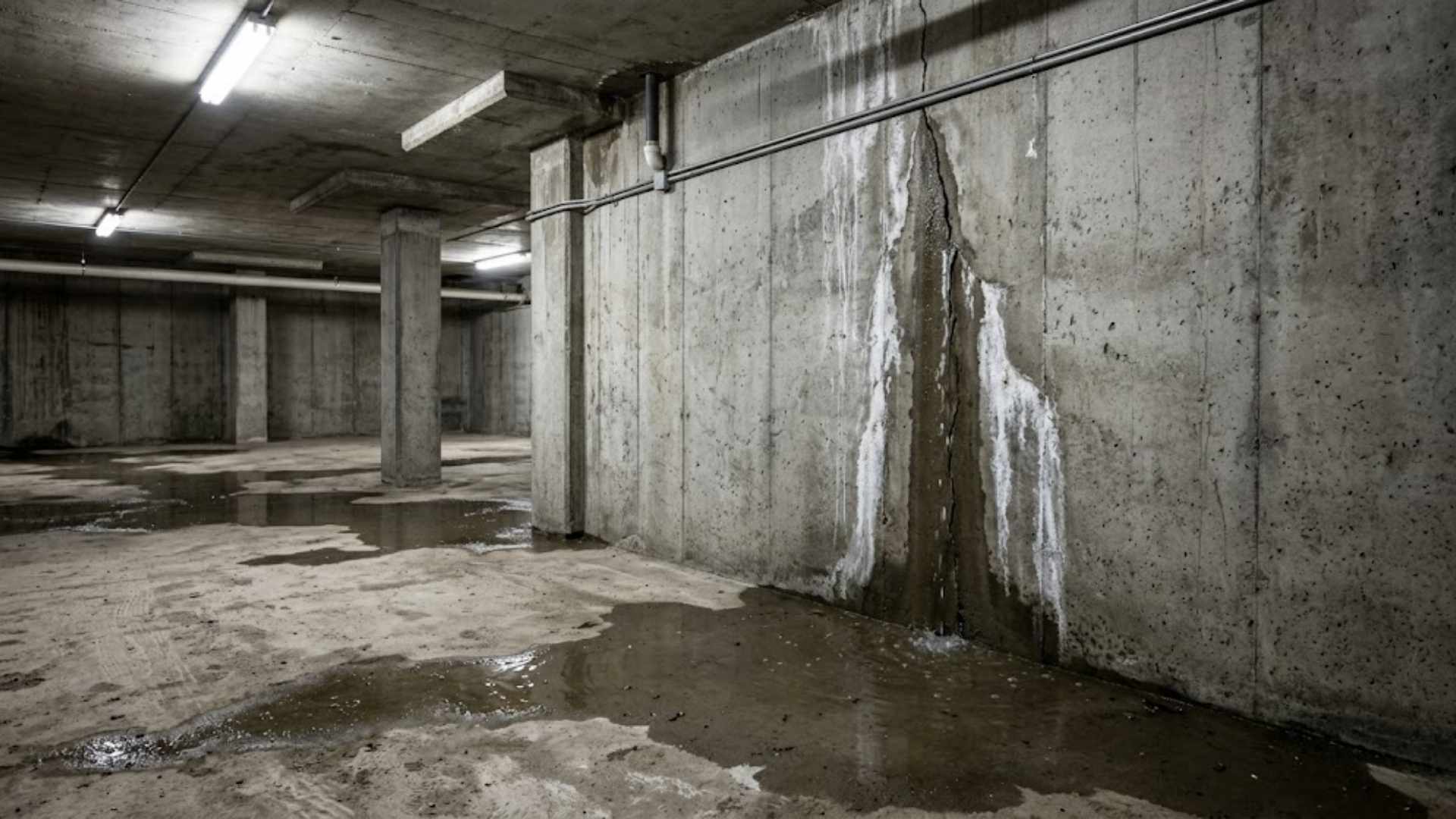
Basement waterproofing is the process of preventing water from entering a below-ground structure — and the right method depends on whether you're addressing an existing water ingress problem or specifying protection for a new structure. If your basement already has damp walls, standing water, or white salt deposits (efflorescence), the most common cause is hydrostatic pressure from groundwater forcing water through cracks, construction joints, or deteriorated membranes. Injection waterproofing can seal these leaks from the inside without excavation, even against active water flow.
The severity of the problem determines both the method and the cost. A damp patch caught early may require only a localised injection repair at a fraction of the cost of a full waterproofing system. Once water ingress progresses to active flow or structural damage, the scope of work — and the price — escalates significantly. This guide covers the three main basement waterproofing approaches, when each one works best, what determines cost, and how to choose between them. Whether you manage a residential basement, commercial sub-level, or underground storage facility, understanding these options prevents you from spending money on a method that doesn't match your problem.
Basement waterproofing means stopping water from entering a below-ground structure and managing any moisture that does penetrate. Under BS 8102:2022, waterproofing systems for below-ground structures fall into three types.
Three main approaches:
The Property Care Association provides detailed guidance on all three waterproofing system types under BS 8102.
When to act:
Basements leak because they sit within or near the water table, where groundwater exerts continuous hydrostatic pressure against every surface. The deeper the basement, the higher the pressure.
Unlike rainwater that drains away, groundwater pressure is permanent. A basement 3 metres below ground level can experience hydrostatic pressure equivalent to 0.3 bar — enough to push water through any gap wider than 0.1 mm. This pressure acts on walls, floor slabs, and every joint in the structure. The BRE's Good Repair Guide 23 — Treating Dampness in Basements provides background guidance on diagnosing basement moisture problems (note: guidance on repair standards has been updated by BS 8102:2022). For current diagnostic methodology, see also BRE's Diagnosing the Causes of Dampness in Buildings.
Water ingress in basements is progressive. Moisture dissolves calcium from the concrete (visible as white efflorescence), widens cracks through freeze-thaw action, and corrodes reinforcement steel — which expands as it rusts, creating further cracking. A small damp patch today becomes standing water within 12–24 months under sustained hydrostatic pressure.
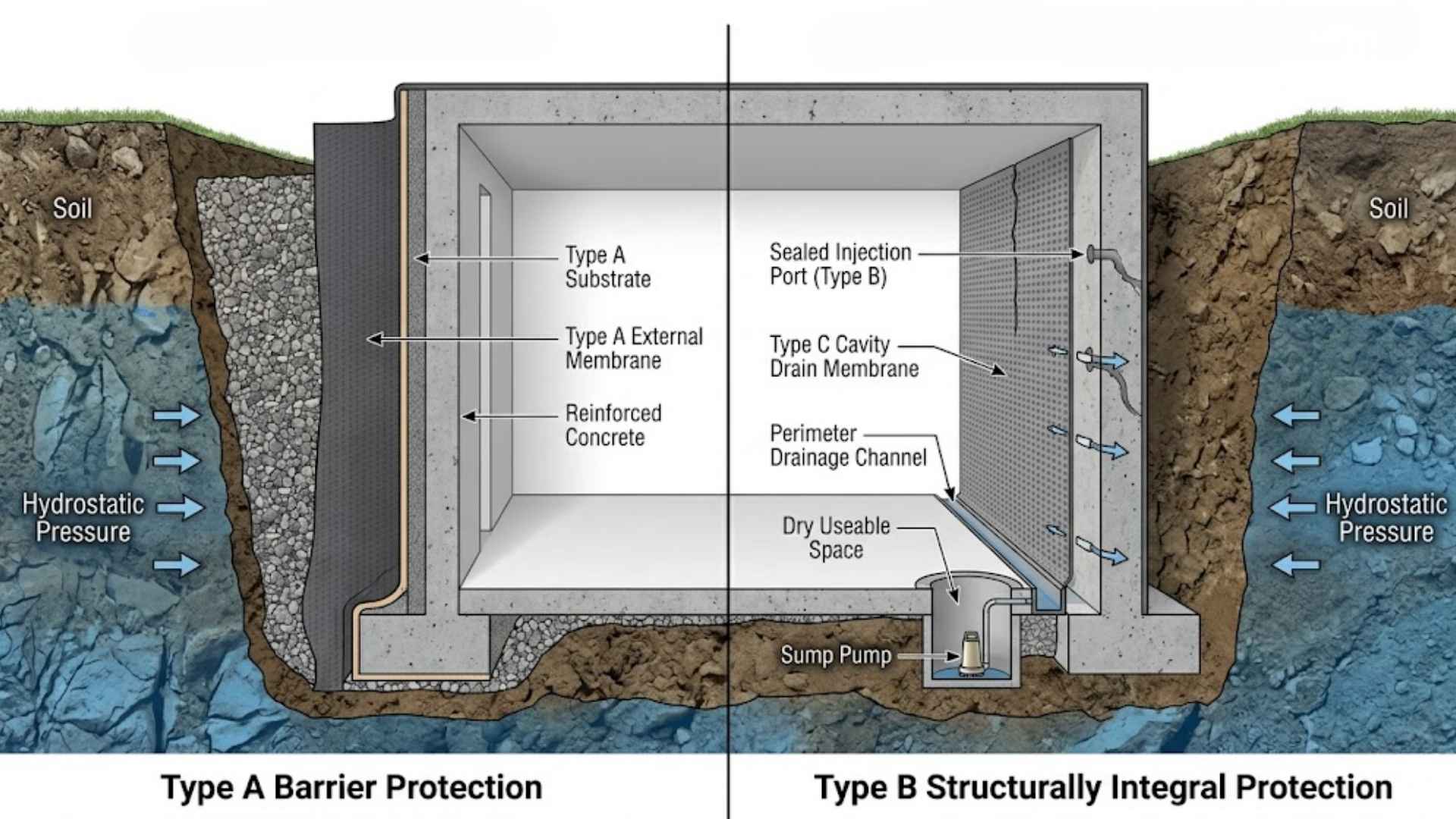
Type A systems place a waterproof barrier between the structure and the surrounding ground. This includes:
Best for: New construction where the exterior is accessible. Provides comprehensive protection when correctly installed.
Limitations: Cannot be installed on existing structures without excavation. Membranes can be punctured during backfilling. Any defect creates a water pathway with no easy repair route — you'd need to dig up the exterior again.
Type B systems make the concrete structure itself the waterproof barrier. This is achieved through:
Best for: Existing structures with active leaks where excavation is impractical. Injection waterproofing is particularly effective because it works from the inside, seals under pressure, and requires no excavation or structural alteration.
How injection works in basements: A certified technician drills small ports along the crack or joint, then injects a waterproofing gel under pressure (typically 80–200 bar). The gel travels through micro-fissures and displaces the water, creating an internal seal. The entire process typically takes 1–2 days for a standard basement, with no need to vacate the building.
Type C systems accept that some water will enter the structure and manage it using:
Best for: High water table situations where eliminating water entry entirely is impractical. Often combined with Type A or Type B for belt-and-braces protection.
Limitations: Relies on mechanical components (sump pumps) that require maintenance and power. If the pump fails, the system fails. BS 8102 specifically recommends dual-system protection (e.g., Type C combined with Type A or B) for Grade 2 and Grade 3 environments to provide redundancy. Creates a reduced room size due to the membrane standoff from walls.
Cost varies significantly depending on the method, the size of the affected area, and the severity of the problem.
Cost ranges are indicative based on UK contractor data (2024–2025). Exact pricing depends on access conditions, crack extent, and water table depth. Request a site survey for a fixed-price assessment.
What drives cost up:
What keeps cost down:
BS 8102:2022 defines grades of use that determine the required level of water protection. Understanding which grade applies to your basement helps specify the right waterproofing system:
Grade 2 and Grade 3 applications typically require a combined waterproofing approach (e.g., Type B + Type C) to provide the redundancy needed for guaranteed dry conditions — a recommendation set out in BS 8102:2022.
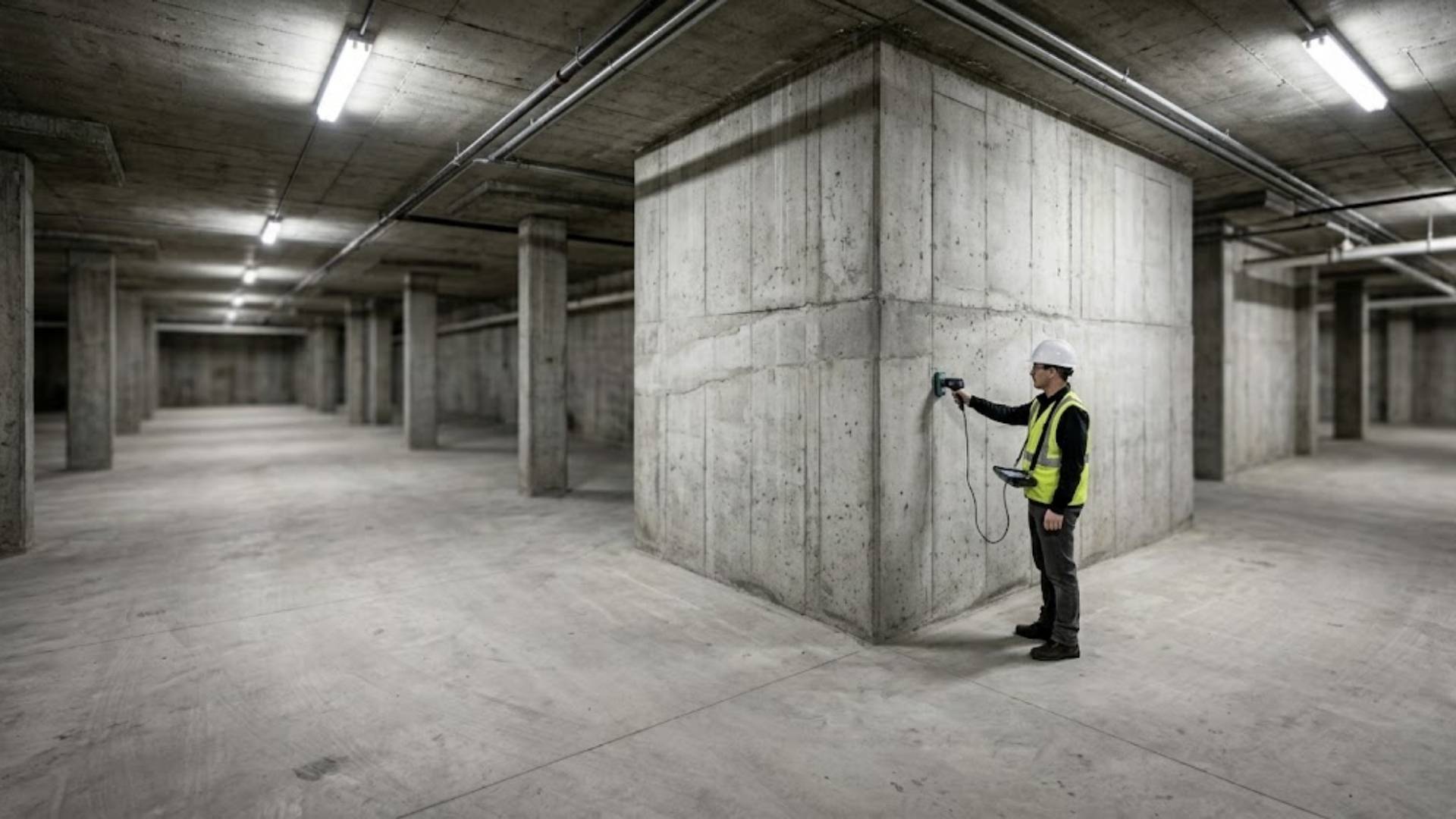
At King's Court, a premium residential complex in Belgrade, chronic basement leaks had persisted for years despite previous waterproofing attempts. Hydrostatic pressure from high groundwater levels was forcing water through settlement cracks in the basement walls and floor slab.
EURAS® Gel Type B was injected under pressure up to 120 bar through small ports drilled into the affected areas. The mineral-based gel penetrated micro-fissures, displaced the water, and created a permanent elastic seal — all without demolition or disruption to residents. The result was complete elimination of active leaks and restoration of dry conditions throughout the basement.
This approach worked where previous membrane repairs had failed because injection addresses water ingress at the source — inside the concrete matrix — rather than attempting to contain it at the surface. Read the full King's Court case study →
EURAS Technology specialises in injection waterproofing for critical infrastructure and below-ground structures across Europe. Our EU-patented mineral gel technology has been protecting basements, car parks, tunnels, and dams for 25+ years — with projects across the UK, Europe, the Middle East, and North Africa.
If you're managing a basement with persistent water ingress despite previous repair attempts, request a site survey to assess whether injection waterproofing can provide a permanent solution without excavation.
Yes. Internal waterproofing methods include injection waterproofing (Type B), which seals cracks and joints from inside the structure, and cavity drain systems (Type C), which manage water that enters. Injection waterproofing creates a seal within the concrete itself and can stop active leaks under pressure — learn more about negative-side injection.
It depends on the method and material. External membranes (Type A) have service lives that vary significantly by material type — standard bituminous sheet membranes typically last 10–20 years, modified bituminous (SBS or APP) membranes can last 20–30 years, and HDPE geomembranes have demonstrated service lives exceeding 50 years. Injection waterproofing with mineral-based gel is designed to be permanent — EURAS® Gel, for example, does not shrink, degrade, or lose elasticity over time. Cavity drain systems last indefinitely but rely on sump pumps that need periodic maintenance and replacement.
In the vast majority of cases, yes — and the data supports it. Untreated water ingress leads to progressive structural damage, reinforcement corrosion, and eventual remediation costs 5–10 times higher than early intervention. Beyond direct costs, water ingress creates liability exposure, reduces property value, and can render below-ground space unusable.
Tanking is a specific type of waterproofing — it refers to applying a cementitious or bituminous coating to the internal surface of a basement to resist water pressure. Waterproofing is the broader category that includes tanking, membranes, injection, drainage systems, and integral concrete design. Tanking alone is often insufficient where hydrostatic pressure is high or the structure has cracks, because the coating bonds to the surface but doesn't seal pathways through the concrete.
Yes. Both injection waterproofing and cavity drain systems are installed entirely from the inside, requiring no external excavation. Injection is particularly effective because it addresses the water pathway directly — gel is injected into cracks and joints under pressure, sealing them from within the concrete matrix.
If water is entering through cracks, joints, or the concrete itself, drainage alone won't solve the problem — you need waterproofing to stop the ingress. If water is pooling because it can't escape (e.g., surface water finding its way in through doorways or ventilation), improved drainage may be sufficient. A professional water ingress survey identifies the source and recommends the appropriate solution.
Yes. A dry, waterproofed basement is usable space. In commercial properties, it means functional storage, plant rooms, or additional lettable area. In residential properties, a professionally waterproofed basement with documentation increases buyer confidence and property value. The presence of an untreated leak does the opposite.
BS 8102:2022 is the British Standard code of practice for protection of below-ground structures against water from the ground. It applies to all new below-ground construction and is the standard reference for specifying waterproofing in existing structures. It defines the three waterproofing types (A, B, C) and recommends that high-risk or high-value basements use a combination of types for reliability.
If your basement is showing signs of water ingress — damp patches, efflorescence, dripping, or standing water — the problem will progress without intervention. The cost of repair increases significantly once water ingress moves from early to intermediate stage, and exponentially once structural damage begins.
Injection waterproofing provides a permanent solution for existing basements without excavation, without disrupting occupants, and without the ongoing maintenance burden of pump-dependent systems.
Request a site survey → Our specialist team will assess the source and severity of water ingress, recommend the most effective and cost-efficient approach, and provide a fixed-price quotation backed by our material and workmanship guarantee.
Related articles:
External references: