
+1 (954) 787-2570

Email: hello@eurastechnology.com


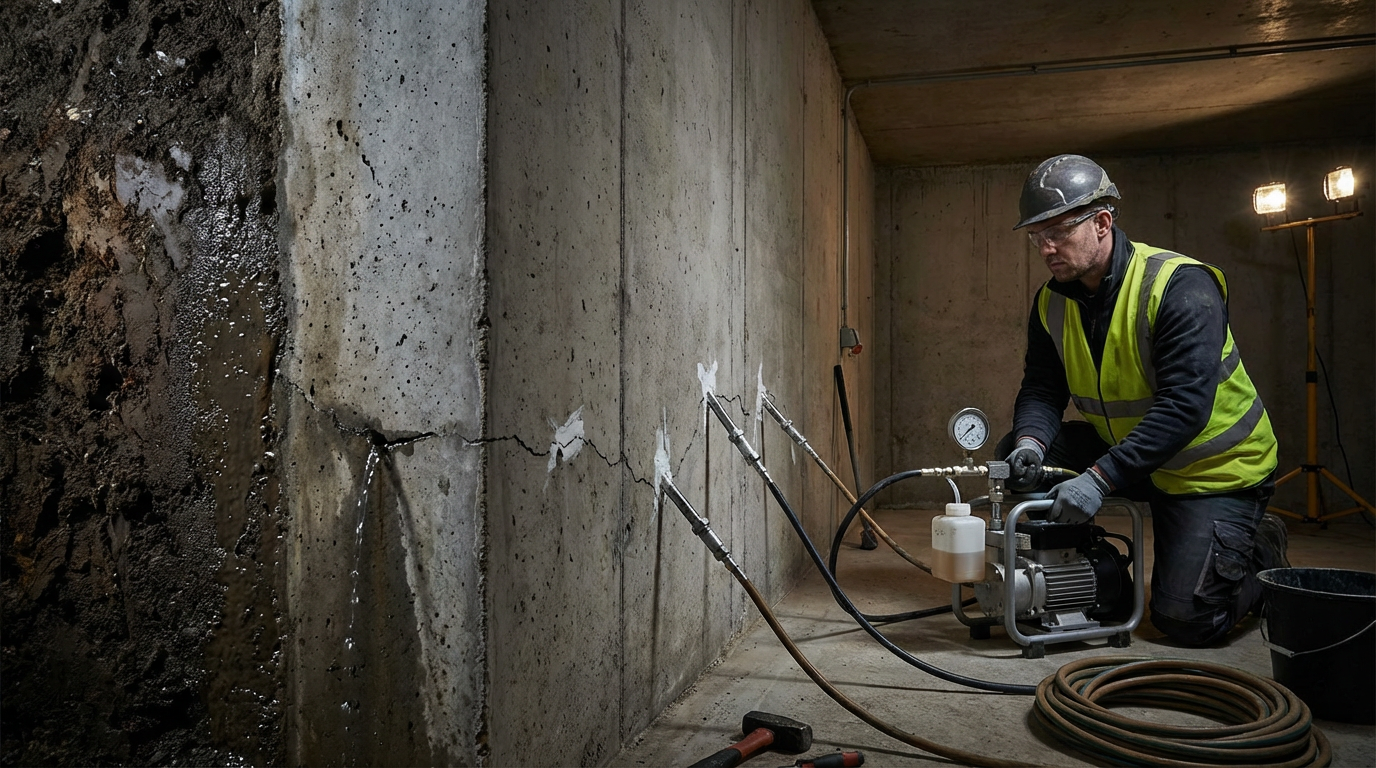
Yes — you can waterproof a concrete structure from the inside, and in most remedial waterproofing projects, working from the interior is exactly how it is done. If you are still tracing why water is entering, our guide to what causes water ingress in underground structures walks through the main pathways and warning signs. Negative-side injection — the technical term for waterproofing applied from the dry interior face of a structure — is used where excavation is impractical, the structure is already built and occupied, or the water pressure is coming from outside.
This guide explains how negative-side injection works, when it is the right choice, what its limitations are, and what realistic outcomes to expect.
Key takeaways:
Quick Summary: Negative-Side Injection Waterproofing
Negative-side waterproofing means waterproofing applied to the face of a structure opposite to where the water pressure originates. In an underground basement or car park, water pressure comes from the outside — so "negative side" is the interior face. Injection waterproofing applied from the inside fills cracks, joints, and voids within the concrete body itself, filling the water pathway permanently within the concrete mass.
Key facts:
The terms "positive side" and "negative side" describe which face of a structure a waterproofing system is applied to — relative to where the water comes from.
Positive-side waterproofing is applied to the face that groundwater contacts directly — the outside of a basement wall, for example. This is the original construction-stage approach: apply a membrane to the exterior before backfilling. Positive-side systems work by keeping water away from the structure entirely.
Negative-side waterproofing is applied to the face opposite the water source — the interior. Rather than keeping water away from the concrete, it seals the pathway through which water is travelling.
For buildings that already exist, excavating to apply a new positive-side membrane is enormously expensive, disruptive, and in many urban settings simply impractical. Negative-side injection is the only realistic remedial option for the vast majority of existing underground structures.
Under BS 8102:2022 — the British Standard for below-ground waterproofing — remedial injection applied from the interior typically falls within the Type A (internal barrier) classification, because a material is introduced to resist water passage through the structure. Where the injected gel works within the concrete body and the structure provides the primary water resistance, a competent waterproofing design specialist may classify the system differently depending on the project. For any scheme where BS 8102 classification matters, confirm the designation with a CSSW-qualified designer. For broader guidance on below-ground waterproofing strategy and investigation, the BRE’s Good Building Guide GG 72 — basement construction and waterproofing (Part 1) sets out investigation and specification principles; engineers often also use CIRIA and institutional guidance alongside the standard.
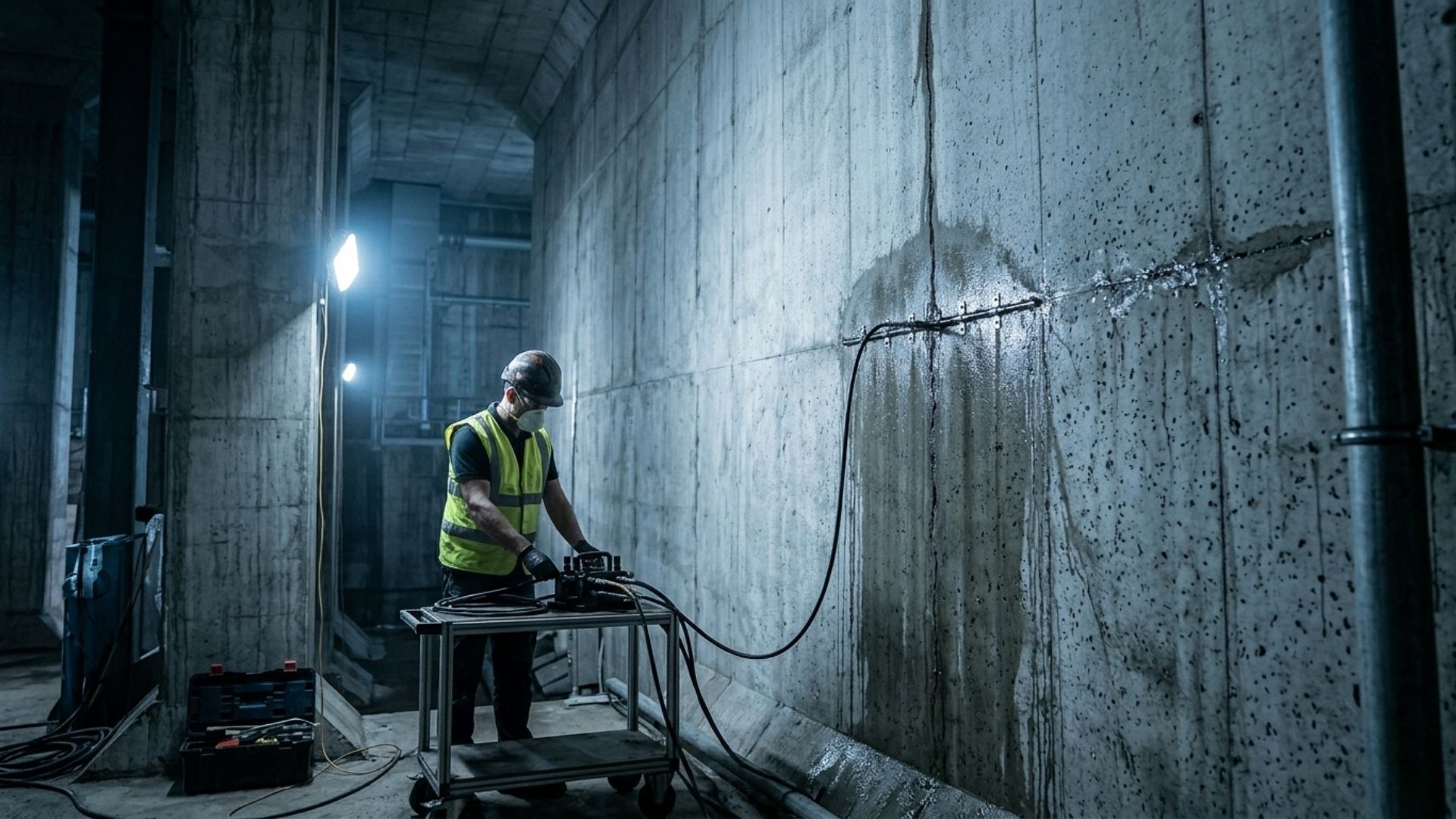
The mechanics of negative-side injection are different from surface coatings or tanking. The goal is not to coat the surface — it is to fill the void, crack, or joint within the concrete that is allowing water to pass through.
Step 1: Survey and mapping Before any injection, a specialist surveys the structure to identify where water is entering. This involves moisture mapping, visual inspection of crack patterns and joint locations, and in some cases non-destructive testing to trace water pathways beneath the surface. In more complex structures, techniques such as ground-penetrating radar and thermal imaging can map moisture migration without extensive opening-up. EURAS’s non-destructive testing service is often used as a precursor to injection specification. Diagnosis is critical — injecting the wrong location wastes material and leaves the problem unsolved.
Step 2: Drilling injection ports Holes are drilled at regular intervals along the identified water pathway. The spacing, angle, and depth of these ports are determined by the width and depth of the crack or joint being treated. Ports are typically spaced 150–300mm apart and drilled at an angle to intersect the crack within the concrete body.
Step 3: High-pressure gel injection Specialist injection gel is introduced through the ports under controlled pressure. The gel — typically a mineral-based, hydrophilic material — advances through the crack network, displacing water as it goes. Hydrophilic gels swell on contact with water, expanding to fill voids that are inaccessible to the initial injection front.
Step 4: Monitoring and verification Flow rate and back-pressure are monitored throughout. When gel begins returning from adjacent ports, the crack network is saturated. Ports are sealed and the treated area is monitored to verify that water flow has stopped.
The entire process requires access only to the interior face — no excavation, no demolition, and in most cases no need to close the building.
Negative-side injection is the appropriate solution when:
For a comparison of negative-side injection with other remedial approaches including tanking and drainage systems, see our guide to injection waterproofing vs tanking.
Injection waterproofing is not a solution for every scenario. Key limitations include:
It treats the symptom unless the cause is addressed. If a crack is actively widening due to ongoing structural movement — from differential settlement, for example — re-injection may eventually be required. A structural engineer should assess any active movement before waterproofing is specified.
Diagnosis quality determines outcome. Poorly targeted injection — treating the visible surface rather than the actual water pathway — will not stop the leak. This is why specialist survey work before injection is not optional: it is the basis for everything that follows.
Material selection matters. Negative-side injection requires a hydrophilic, elastic material that can displace and work against active water. Rigid or hydrophobic materials that require a dry substrate are not suitable. Understanding the cost implications of choosing the right method is part of correct specification.
Highly deteriorated concrete may require repair first. If the concrete is so degraded that it cannot hold injection pressure, surface consolidation or structural repair may be required before injection.
The term "negative-side waterproofing" is sometimes used loosely to include cementitious tanking — a mortar slurry applied to interior walls. These are very different systems with very different performance profiles.
Cementitious tanking is a viable option for controlling moisture seepage in structures with low hydrostatic pressure. For structures with active water ingress under significant pressure — which describes most underground basements and car parks near the water table — injection is the more reliable solution.
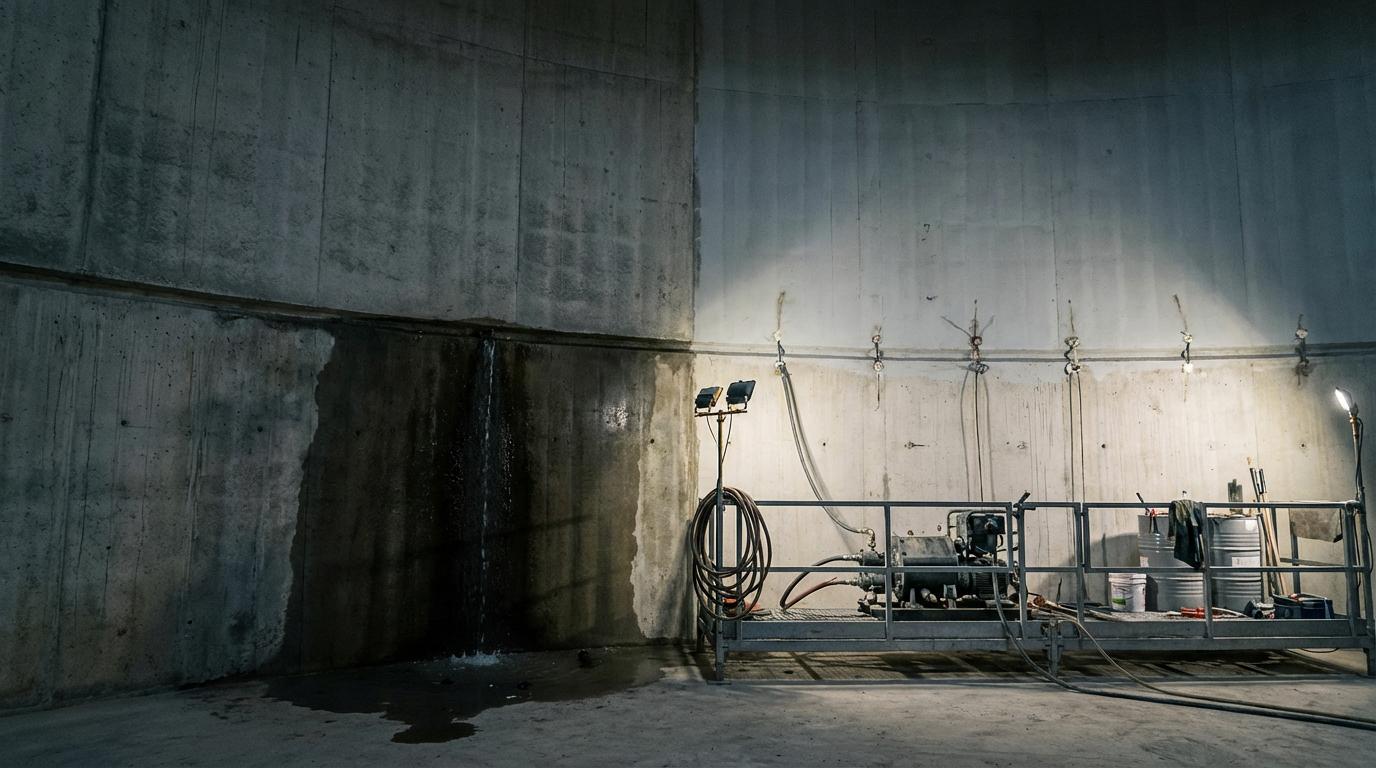
One of the most demanding examples of negative-side injection in our project history is the Hoch-Behälter potable water reservoir in Usingen, Germany. The underground reservoir had developed persistent leaks through construction joints and micro-cracks — from the inside, because the water source was the stored potable water itself pressing outward, as well as groundwater pressing inward.
The complication was the potable water environment. Any injection material needed to be certified as safe for contact with drinking water. Using EURAS® Gel Type B — which carries the relevant potable water certifications — our team injected the construction joints and crack networks from the interior under pressures up to 140 bar, achieving complete watertightness without emptying or taking the reservoir out of service.
The project demonstrates that negative-side injection, when correctly specified with the right materials, delivers permanent results even in the most sensitive environments.
EURAS Technology has been solving water ingress in underground structures from the inside for 25+ years — across basements, reservoirs, car parks, and industrial facilities. Our EU-patented mineral gel technology was specifically developed for negative-side application under active water conditions. If your structure has water ingress that needs to be addressed from the interior, our specialists can assess the right approach.
Is negative-side injection as effective as positive-side (external) waterproofing? For remedial work on existing structures, yes — correctly applied negative-side injection can achieve the same watertightness as a new external membrane, at a fraction of the cost and disruption. The key is accurate diagnosis and correct material selection.
Can negative-side injection work on very high water pressure? Yes, provided the injection system is rated for the required pressure. EURAS® Gel Type B has been injected at up to 200 bar in dam gallery applications. For most underground basements and car parks, groundwater pressures are significantly lower than this.
Does negative-side injection require the building to be vacated? No. In virtually all cases, the structure can remain occupied during injection waterproofing. Works are typically cordoned off within the affected area, but the rest of the building operates normally.
How long does the injection gel last? Provided the structural movement that caused the crack is not ongoing, injection gel is a permanent repair. The material does not shrink, dry out, or degrade. Projects carried out over 20 years ago continue to show complete watertightness in follow-up inspections.
What is the difference between hydrophilic and hydrophobic injection gels? Hydrophilic gels swell on contact with water and are specifically designed for negative-side injection against live water. Hydrophobic gels repel water and are better suited to dry or damp conditions. For active leaks under negative-side pressure, hydrophilic mineral gels are typically the correct specification.
Can I inject a crack myself, or does it require a specialist? Specialist equipment, training, and material knowledge are required. The pressure levels involved — and the consequences of injecting the wrong location — mean that injection waterproofing should not be attempted without specialist qualifications and experience.
Does BS 8102 cover negative-side injection? Yes. BS 8102:2022 classifies waterproofing into Type A (barrier), Type B (structurally integral concrete as constructed), and Type C (drained cavity). Remedial injection from the interior is usually treated as Type A (an internal barrier formed within or on the structure). A CSSW-qualified designer should confirm how your repair should be described for compliance and warranty purposes.
Is negative-side injection safe for potable water structures? When the correct certified material is used, yes. EURAS® Gel Type B carries certification for use in potable water contact environments. Not all injection gels have this certification — confirm this before specifying any material for a reservoir, water tower, or treatment plant application.
Negative-side injection has made it possible to permanently waterproof thousands of existing underground structures that would otherwise require disruptive and enormously expensive excavation. Applied correctly — with accurate diagnosis, appropriate gel selection, and controlled injection pressure — it delivers permanent results by sealing within the concrete itself, not merely over it.
Next step: If your underground structure has active water ingress and you need to resolve it from the inside, request a no-obligation specialist assessment. Our team will identify the water pathway, specify the right injection system, and provide a clear, costed recommendation. Facing an active leak right now? Our emergency leak repair team can mobilise quickly.


