+1 (954) 787-2570

Email: hello@eurastechnology.com


Tunnels leak primarily because the concrete or masonry lining that forms the tunnel's structure develops cracks and joint failures over time, allowing surrounding groundwater to enter under pressure. Even tunnels that were watertight when constructed will typically develop water ingress issues as the structure ages, the waterproofing system deteriorates, and ground conditions change.
This guide explains the specific mechanisms that cause tunnel water ingress, why tunnels face different challenges from other underground structures, and what the consequences are when ingress goes unaddressed.
Key takeaways:
Quick Summary: Why Tunnels Leak
Tunnels are surrounded by groundwater on all sides. Any failure in the lining — a crack, joint gap, or construction defect — creates an immediate pathway for water entry under hydrostatic pressure. Unlike buildings, tunnels cannot be easily excavated for external repairs; all remedial waterproofing must be done from inside.
The main causes of tunnel water ingress:
Compared to basements or underground car parks, tunnels present a fundamentally more demanding waterproofing environment:
360-degree groundwater exposure. A basement has a floor, walls, and a roof — but three of those surfaces are exterior. A tunnel lining is entirely surrounded by ground and groundwater. Every point of the lining is a potential ingress point under continuous pressure.
No access from the outside. In most operational tunnels — particularly rail and road tunnels — gaining access to the exterior of the lining is impractical or impossible without taking the tunnel out of service. All inspection and repair must be performed from inside the tunnel, working against the direction of water pressure.
Operational continuity requirements. Railway tunnels operate within maintenance possession windows — often overnight, for limited hours. Road tunnels cannot be closed without major disruption. This severely constrains when and how repairs can be carried out.
Length and variability. A long tunnel passes through varying geology, crossing groundwater zones of different character, and often through areas of different construction method. Water ingress may occur at specific geological transitions, old repair zones, or particular lining design details. For UK tunnelling professional context and technical community resources, see the British Tunnelling Society.
Understanding the fundamentals of what causes water ingress in underground structures provides useful background, but tunnel-specific mechanisms require separate consideration.
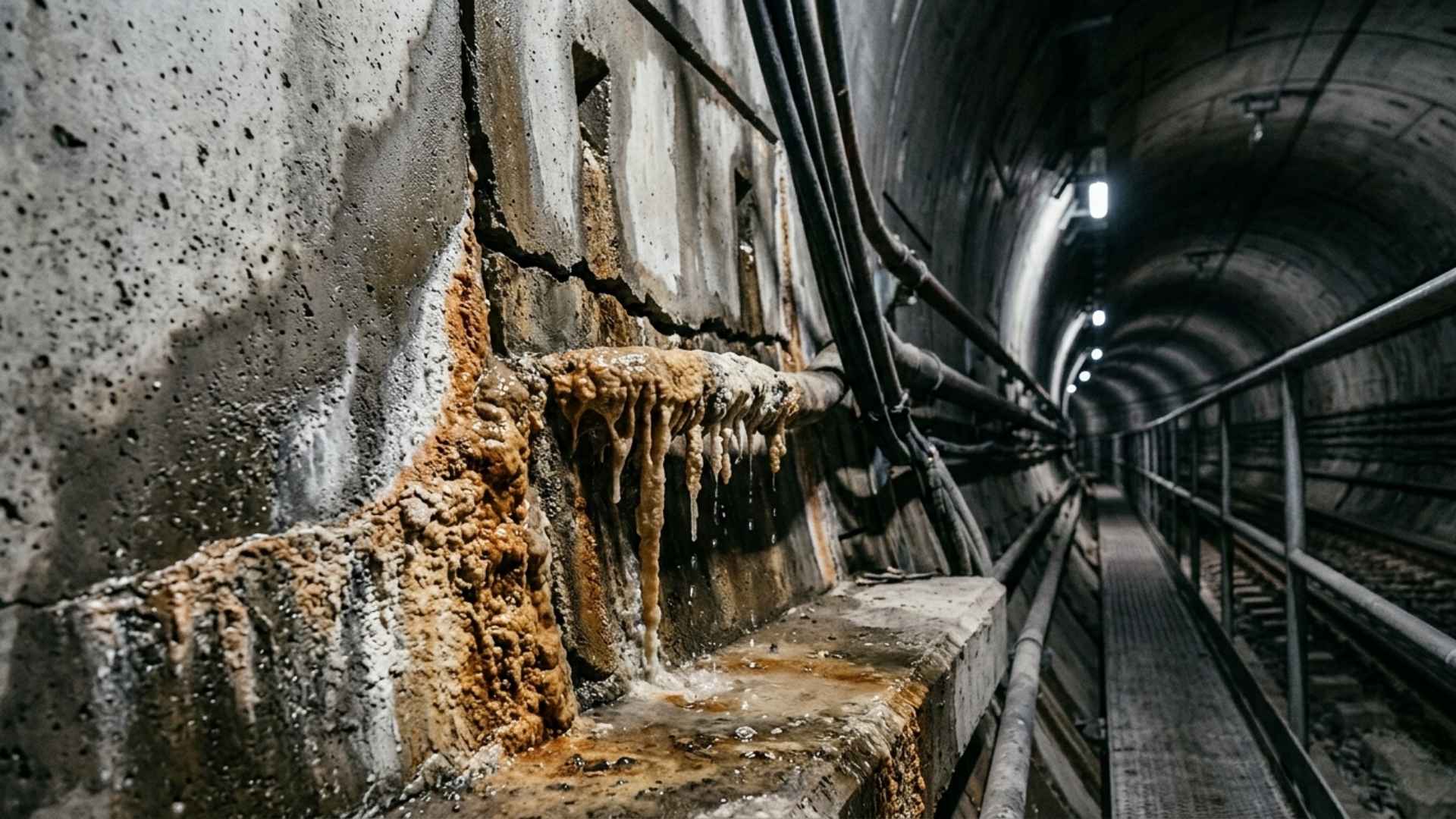
In cast-in-place concrete tunnels, the lining is poured in sections. The interfaces between pours — construction joints — are inherent points of weakness. Even where waterstops are incorporated, these can be displaced during construction or degrade over time. In older tunnels, construction joints are typically the primary water entry point.
In bored tunnels using precast concrete segment linings, the joints between segments are the critical waterproofing challenge. Gaskets and sealants in these joints must accommodate the settlement and ground pressure movements that occur after installation. As gaskets age, compress, or are damaged by maintenance activity, they allow water ingress — often in concentrated drips or flows at specific ring positions.
Concrete linings undergo shrinkage during curing and then continue to crack due to thermal cycling as the tunnel environment changes seasonally and operationally. In tunnels with significant diurnal or seasonal temperature variation — Alpine railway tunnels, for example — crack widths can open and close by fractions of a millimetre daily. Over years, this cycling gradually widens cracks enough to allow water infiltration. For how non-structural cracks are classified in concrete, see the Concrete Society TR 22 overview on NBS (4th edition).
Many tunnels built in the 20th century incorporated a bituminous or PVC sheet membrane between the primary and secondary lining. These membranes have finite lifespans and can be damaged during construction, punctured by fixing anchors, or degraded by chemical attack. Once the membrane fails in one location, water migrates laterally between the linings and can emerge at multiple points far from the actual breach.
Tunnels in areas of subsidence, dewatered ground, or seismic activity experience ground movements that induce cracking in the lining. Rail tunnels experience constant vibration from train loads — over decades, this vibration fatigues the connections and interfaces within the lining, particularly at invert level where water naturally collects.
Cut-and-cover tunnels — constructed by excavating a trench, building the structure, and backfilling — behave more like underground basements. Their vulnerability is concentrated at roof-to-wall junctions, floor joints, and external membrane failures. Remedial injection from the inside is straightforward to access.
Bored tunnels — constructed using a tunnel boring machine — have circular cross-sections with segment ring joints as the primary vulnerability. The cylindrical geometry creates challenging access for repair works. Injection into ring joints requires specialist equipment designed for the confined, curved geometry.
Sprayed concrete linings (SCL) — used in NATM-method tunnels — are inherently variable in thickness and have no formal joint layout. Water ingress through SCL tunnels tends to occur through areas of thinner concrete, annular gaps, and interfaces with cast concrete sections.
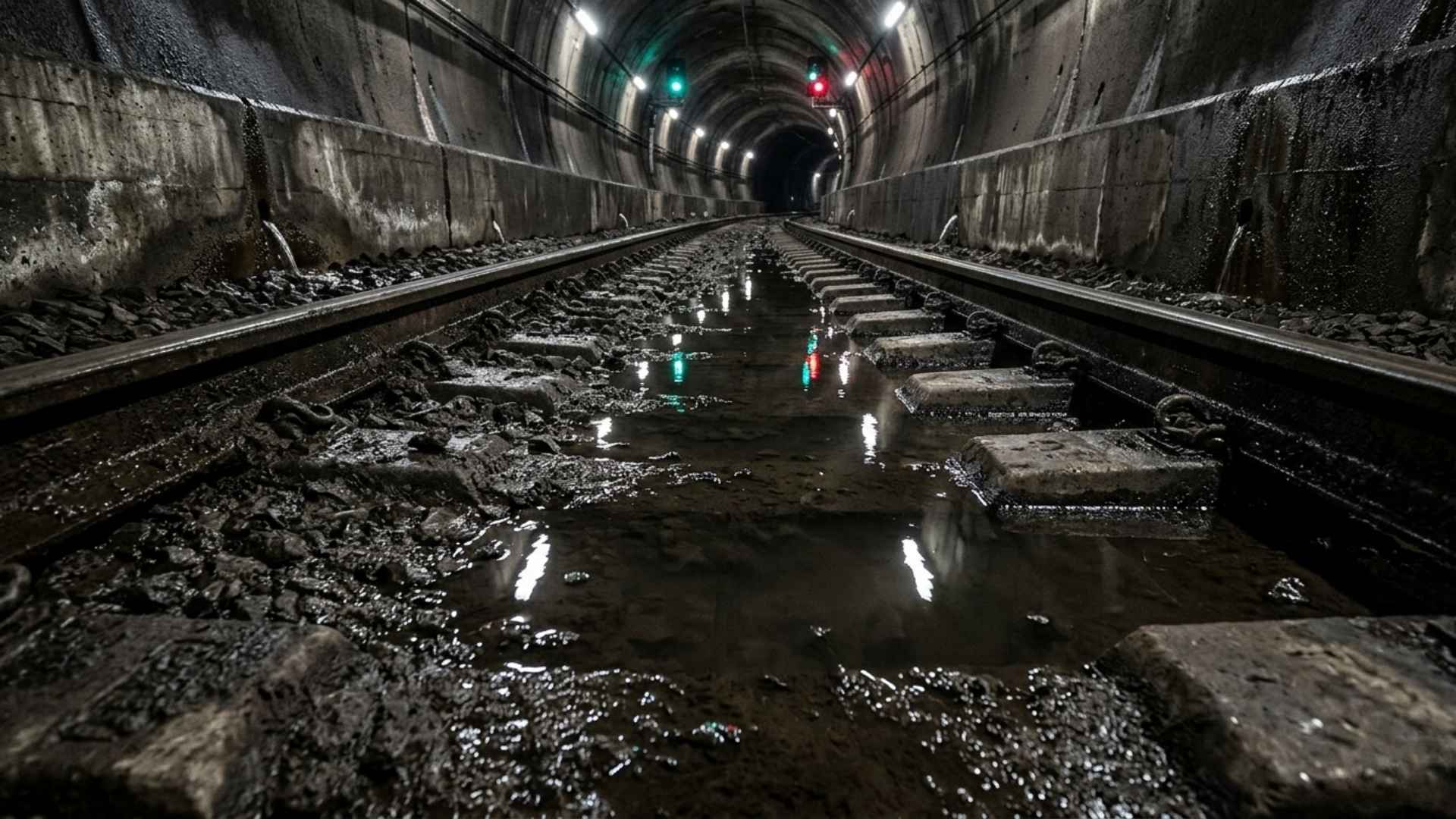
The consequences of unaddressed tunnel water ingress are severe relative to most other structure types:
Track and road bed damage. Water pooling on the invert degrades ballast, erodes the track bed, and creates maintenance problems that extend beyond waterproofing. In electrical rail systems, water on the track is also a direct safety risk.
Reinforcement corrosion. Chloride-bearing groundwater is particularly aggressive. In tunnels with reinforced concrete linings, chloride penetration initiates corrosion that can lead to spalling of the lining — creating a falling debris hazard in a live operational environment.
Electrical and mechanical systems. Tunnel drainage pumps, lighting, signalling equipment, and ventilation systems are all vulnerable to persistent water ingress. The cost of repairing or replacing electrical and mechanical damage in a tunnel can run to multiples of the waterproofing repair cost once cabling, plant, and extended possessions are included.
Icing in cold climates. In tunnels exposed to winter temperatures, water ingress that is not dealt with creates ice on walls and ceilings — a severe safety hazard for both passengers and maintenance personnel. Alpine and Northern European tunnels face this risk every winter.
Restricted remediation access. The longer water ingress continues, the more widespread the damage becomes. Repairs that could have been accomplished in a short maintenance possession window may eventually require extended closures if the lining deteriorates substantially.
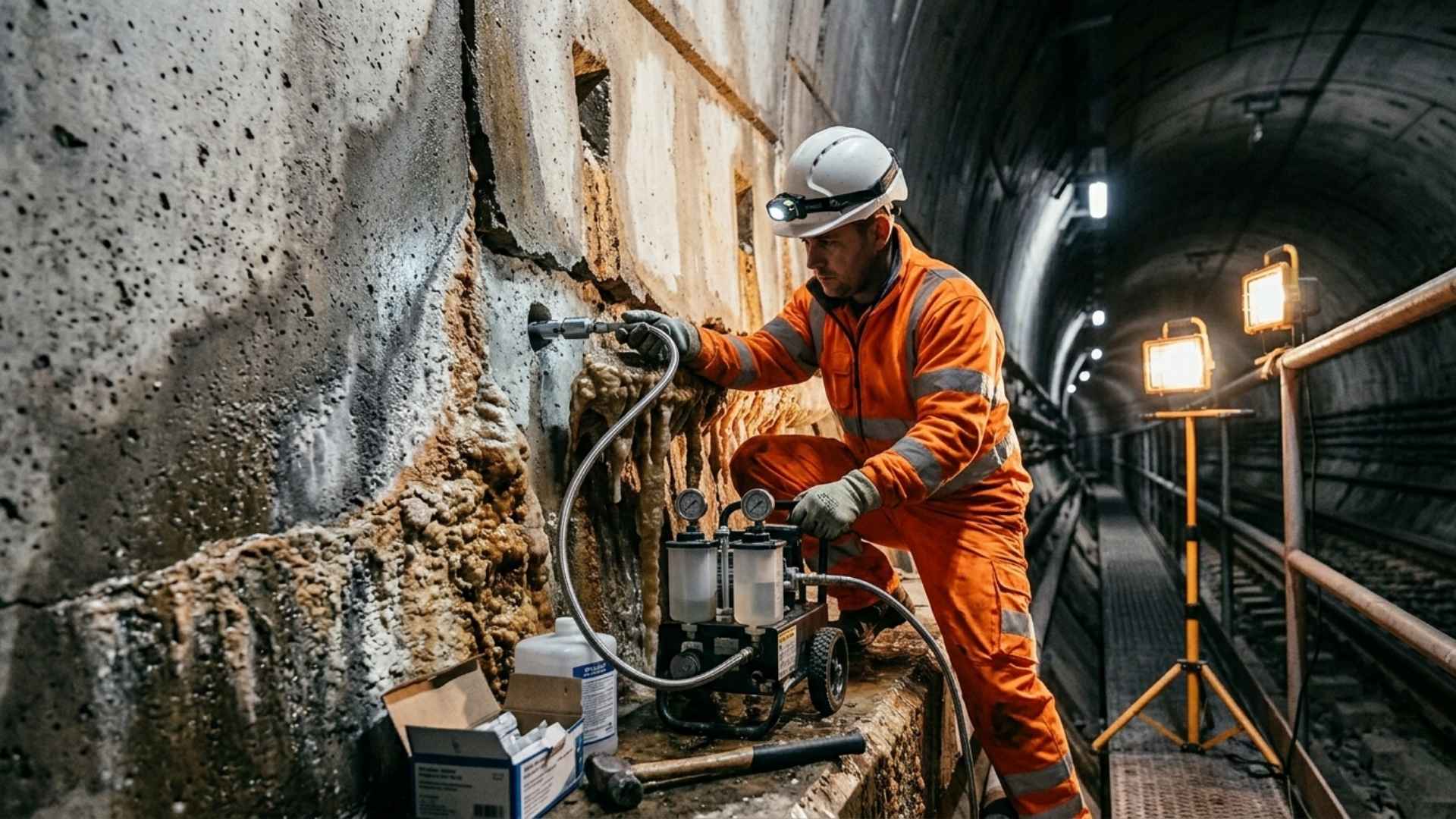
In live operational tunnels, high-pressure injection from the inside is the standard repair method. High-pressure gel injection uses the same core technology as other EURAS underground waterproofing work — drilling ports, injecting elastic mineral gel, monitoring and verifying — but with constraints specific to tunnels:
For facilities managers responsible for tunnel infrastructure, our tunnel waterproofing service outlines what to expect from a specialist contractor and how projects are typically scoped. For how structurally integral (Type B) waterproofing is classified in UK practice, see PCA guidance on structural waterproofing. For active flow and pressure-driven leaks, see injecting an actively leaking crack under pressure.
Railway tunnels are among the most demanding waterproofing environments we work in. The Neuer Kaiser Wilhelm Tunnel in Cochem, Germany is a critical 4.2 km railway corridor along the Moselle River operated by DB Netz AG. Despite previous rehabilitation works, sections of the tunnel continued to experience active water ingress at construction joints in the invert and walls — creating standing water on the track bed and accelerating maintenance costs.
Working in scheduled overnight possessions, our team injected EURAS® Gel Type B at up to 180 bar — permanently sealing all treated sections without affecting train operations. The project required precise planning around possession windows, specialist injection equipment suitable for the confined environment, and materials capable of sustaining the groundwater pressure after injection was complete.
EURAS Technology specialises in injection waterproofing for critical infrastructure — rail tunnels, road tunnels, hydropower galleries, and subsea structures. Our EU-patented mineral gel technology has been deployed across tunnel projects in Germany, Cyprus, Serbia, Switzerland, and Algeria, working within live operational constraints for over 25 years.
If your tunnel infrastructure is showing similar signs — track-bed water, joint weeps, or accelerating maintenance at known weak details — our specialists can assess the structure and design a repair programme that fits your operational constraints.
Contact our infrastructure team
Why do even newly constructed tunnels sometimes leak? New tunnels can experience water ingress if waterproofing membranes are damaged during construction, if construction joint waterstops are incorrectly positioned, or if the concrete lining develops early-age shrinkage cracking before backfilling. Construction-stage defects are more common than often acknowledged and can be difficult to identify until groundwater pressure is applied.
How do engineers find where a tunnel is leaking? The investigation typically combines visual inspection, moisture mapping, flow measurement at identified points, and in some cases borehole cameras inserted through the lining to inspect behind it. Tracing where water enters from can be complex in tunnels where membrane failures allow lateral water migration far from the actual defect.
Can tunnel injection be carried out with trains running? No. All injection works in railway tunnels are performed in possession windows when the line is closed to traffic. Works planning must accommodate the possession schedule, which may limit the hours available per shift and the total programme duration.
Is tunnel water ingress getting worse because of climate change? Increased rainfall intensity and rising groundwater levels in some regions are increasing the hydrostatic pressures on tunnel structures. Tunnels designed for historical groundwater conditions may be experiencing ingress that was not a problem when they were built. See our guide to what causes water ingress in underground structures for broader context on groundwater pressure and vulnerability.
What is the difference between a bored tunnel and a cut-and-cover tunnel for waterproofing? A bored tunnel has a circular cross-section with ring joints between precast segments — the main waterproofing challenge is the joints between segments. A cut-and-cover tunnel behaves more like a buried box structure — the main challenges are construction joints, roof-to-wall junctions, and external membrane condition. Different tunnel types require different inspection methods and repair approaches.
How much does tunnel waterproofing repair cost? Tunnel waterproofing repair costs vary significantly depending on tunnel type, possession schedule, groundwater pressure, access logistics, and the extent of treatment required. Unlike typical basement or car park injection, possession constraints and operator safety requirements in live rail and road tunnels usually increase cost substantially for an equivalent treated length. Industry benchmarks are highly context-specific — a specialist condition survey and scoped proposal are the only reliable basis for budgeting. Contact our infrastructure team to discuss assessment and indicative programme.

Every tunnel faces sustained groundwater pressure for its entire operational life. Water ingress is not a sign that the structure is failing — it is a predictable consequence of concrete ageing and joint movement under pressure. The question is not whether water ingress will occur, but how promptly it will be addressed when it does.
Caught early, tunnel water ingress is a manageable repair. Left to progress, it becomes a safety issue, a programme constraint, and a significantly more expensive problem.
Next step: If you manage tunnel infrastructure and are seeing signs of water ingress — dripping joints, standing water, efflorescence, or corrosion staining — request a no-obligation site survey. Our team will assess the structure, identify ingress mechanisms, and recommend a repair programme that fits your operational schedule.