+1 (954) 787-2570

Email: hello@eurastechnology.com


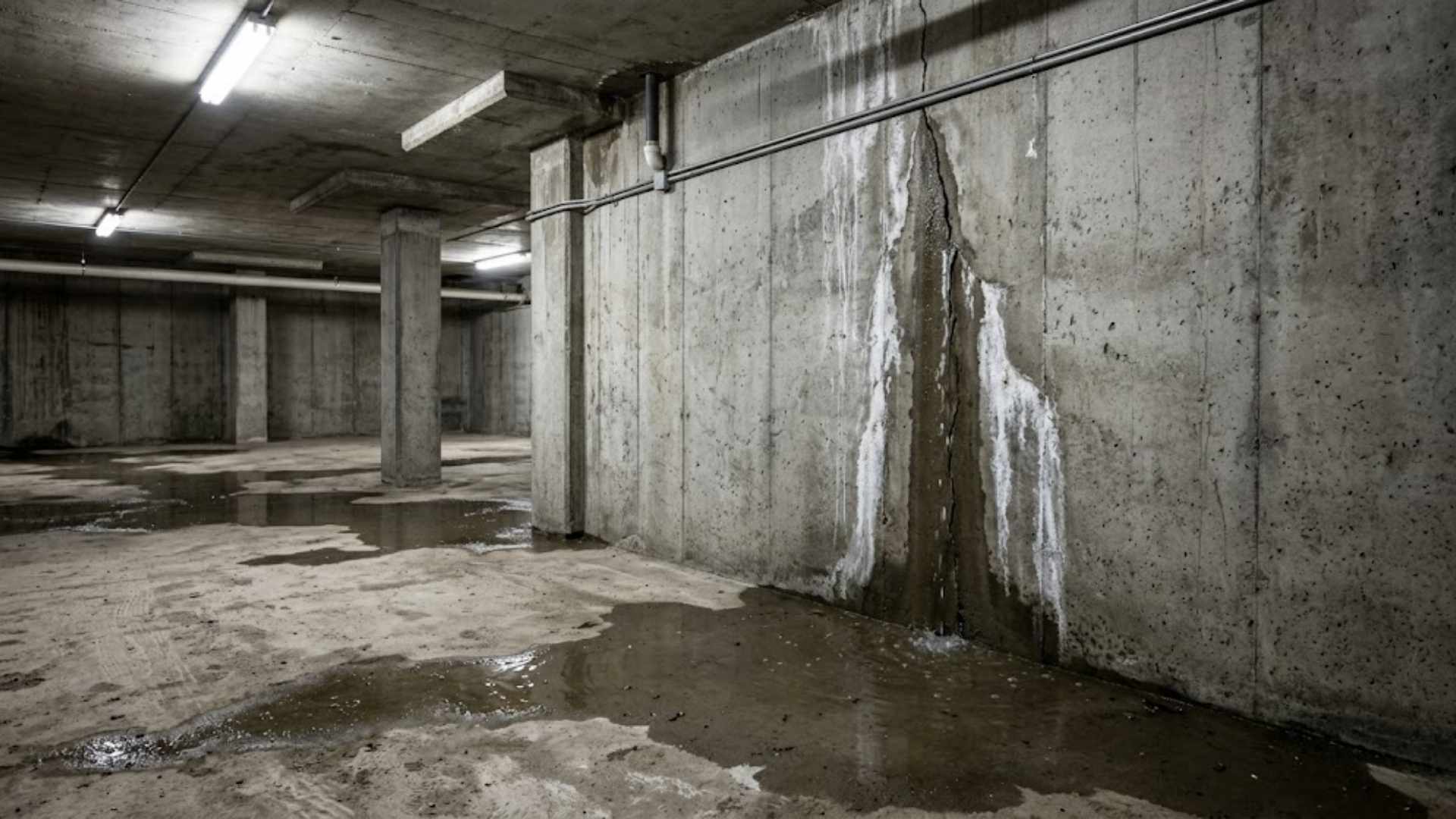
Misidentifying the hydraulic condition is one of the most common causes of injection repair failure. Active water flow and passive damp seepage look similar on the surface but behave in entirely different ways under repair conditions — and they respond to entirely different materials. The cost of a failed first injection — remobilisation, re-assessment, re-injection, and any follow-on structural work — often exceeds the original repair budget by a wide margin.
This article defines both conditions precisely, explains how to distinguish them in practice, and sets out the treatment implications for each.
The difference between active water flow and damp seepage is not degree — it is a fundamentally different hydraulic condition that changes material selection, injection technique, and repair sequence.
The consequence of misidentifying the hydraulic condition is direct and measurable: material failure. Portland cement grout — commonly used for patch repair — will not set in contact with actively flowing water. The water-cement ratio is disrupted; the grout is washed out before hydration can occur. Similarly, two-part epoxy injection resins require a clean, damp-but-not-saturated crack surface; under active flow, the epoxy is swept out of the crack faster than it can cure.
Conversely, specifying a rapid-curing foam or fast-setting gel in a structure where the condition is merely damp seepage is over-engineering — and may create brittleness or a poor bond that will fail when the structure moves.
A correct pre-injection site assessment is not optional — it is the foundation of every subsequent material and method decision.
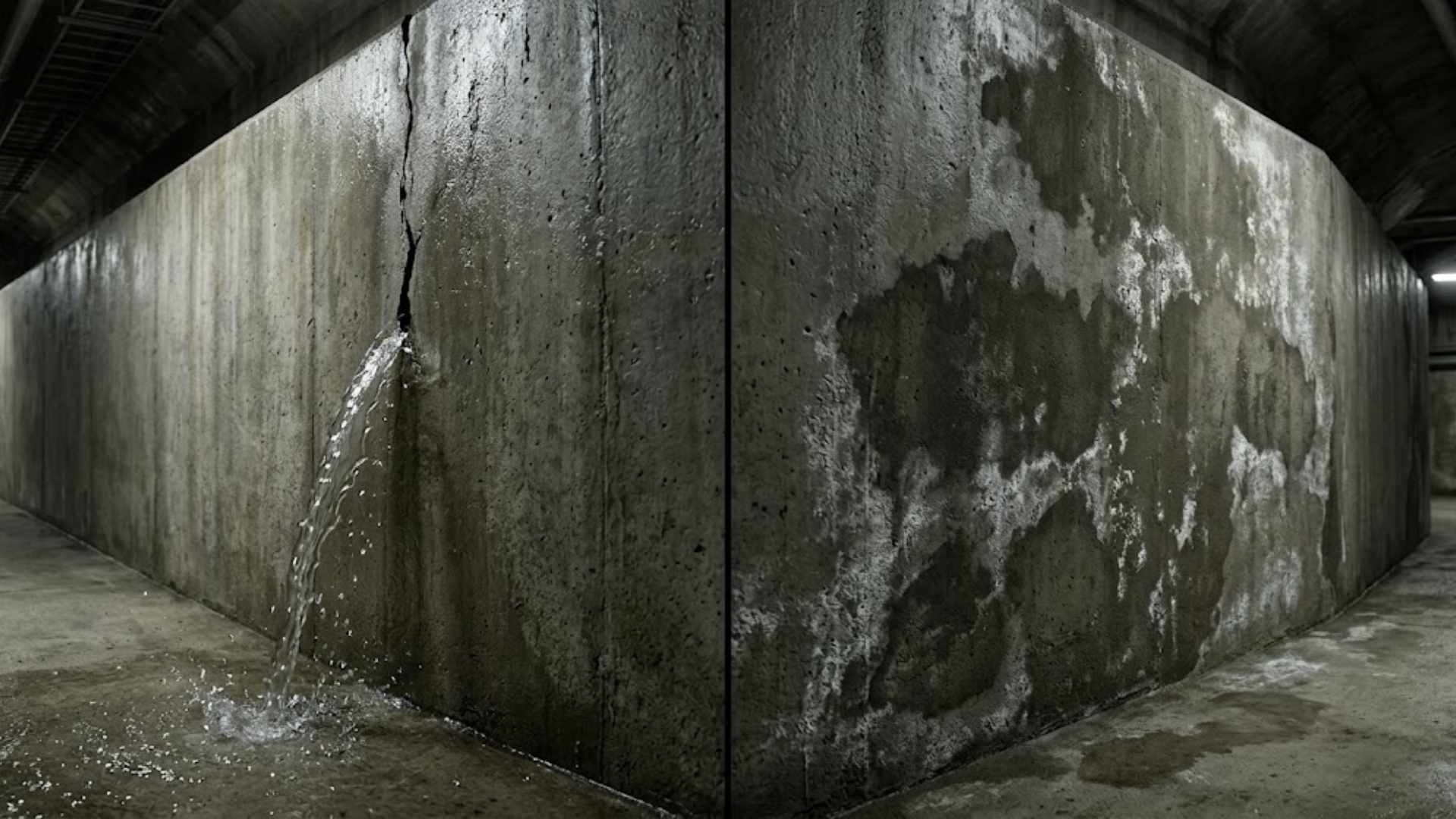
Active water flow is present when water under a hydraulic head is moving through a defined pathway in the concrete — a crack, joint, or void. The defining characteristic is movement: water is flowing from a high-pressure zone to a low-pressure zone through the structure, not simply migrating through pores.
Observable indicators:
Flow rate classification (for injection specification):
Flow-rate bands are indicative operational labels used in the field; thresholds are not fixed in a single universal standard — confirm classification against your contractor’s assessment protocol and manufacturer guidance.
Damp seepage is the migration of water through the concrete matrix itself — through capillary pores, micro-cracks below visible resolution, and the interfacial zones between aggregate and cement paste. It is not a concentrated flow through a single pathway; it is distributed moisture transport.
Observable indicators:
The capillary mechanism:
Portland cement concrete is inherently porous at the micro-scale. The capillary pore network that forms during hydration provides the pathway for damp seepage. If this network connects the exterior wet face to the interior dry face — even without a macroscopic crack — water will migrate under capillary tension and osmotic pressure.
The mechanisms of moisture transport through concrete — including capillary absorption, permeation, and diffusion — are discussed in technical depth in Concrete Society TR 31: Permeability Testing of Site Concrete. Capillary pores in hydrated cement paste are typically in the range of tens of nanometres to about 10 micrometres in diameter — invisible without microscopy, yet able to move significant moisture given hydraulic head and time (Springer: review of pore characterisation in cement-based materials).
A systematic four-step assessment procedure distinguishes active flow from damp seepage reliably:
Step 1: Visual and tactile inspection Examine the concrete surface for point-source ingress versus distributed dampness. Run a finger across the surface — does water flow from the contact point, or does the surface simply feel wet?
Step 2: Dye injection test (for suspected active flow) If a crack appears to be an active conduit, a small quantity of water-soluble dye (fluorescein or similar) can be applied to the exterior face. If dye appears on the interior within a short period, active flow through a defined pathway is confirmed.
Step 3: Moisture meter profiling A calibrated surface electrical resistance moisture meter can profile the moisture distribution across a wall or slab area. Active flow tends to produce a concentrated high-moisture zone at the crack or joint with lower relative readings in surrounding areas. Damp seepage produces a more distributed high-moisture zone with gradual edges.
Step 4: Non-destructive structural assessment For complex or large-area conditions, ground-penetrating radar or infrared thermography (non-destructive testing methods) can map the subsurface moisture distribution and identify voids or delaminations that may be providing a flow pathway not visible at the surface.
Active water flow cannot be treated with standard injection gel as a first step. The flowing water will prevent gel from setting and will carry gel material away from the target zone before it can cure. The correct treatment sequence is:
Phase 1: Flow stoppage
Two approaches depending on flow rate:
Hydrophilic expanding foam: Injected directly into the flowing crack, the foam reacts with water and expands to fill the void rapidly, physically stopping the flow. Foam alone is not a permanent waterproofing solution — it is a temporary plug to allow Phase 2.
Fast-setting mineral gel (rapid-cure formulation): Some mineral gel systems include a rapid-cure version that gels in seconds on contact with water. These can stop moderate-volume active flow and simultaneously begin providing a permanent elastic seal.
Phase 2: Permanent waterproofing
Once flow is stopped and the repair zone is stable:
Phase 3: Surface restoration
Surface-applied crystalline waterproofing or polymer-modified mortar can be applied over the treated area to provide redundancy. This is secondary to the injection repair, not a substitute for it.
Damp seepage through a capillary pore network requires a different approach: the injection material must have sufficiently low viscosity to enter fine capillary-scale pathways, and it must be injected at low pressure over a sustained period to allow full permeation.
Specification points:
Note: If a structure shows both damp seepage and active flow through separate pathways, the active flow locations must be treated first. Attempting to permeation-inject a seepage zone adjacent to an active flow crack will result in the gel following the active flow pathway rather than filling the capillary network.
Learn more about crystalline waterproofing as a complementary treatment to injection for distributed seepage conditions.
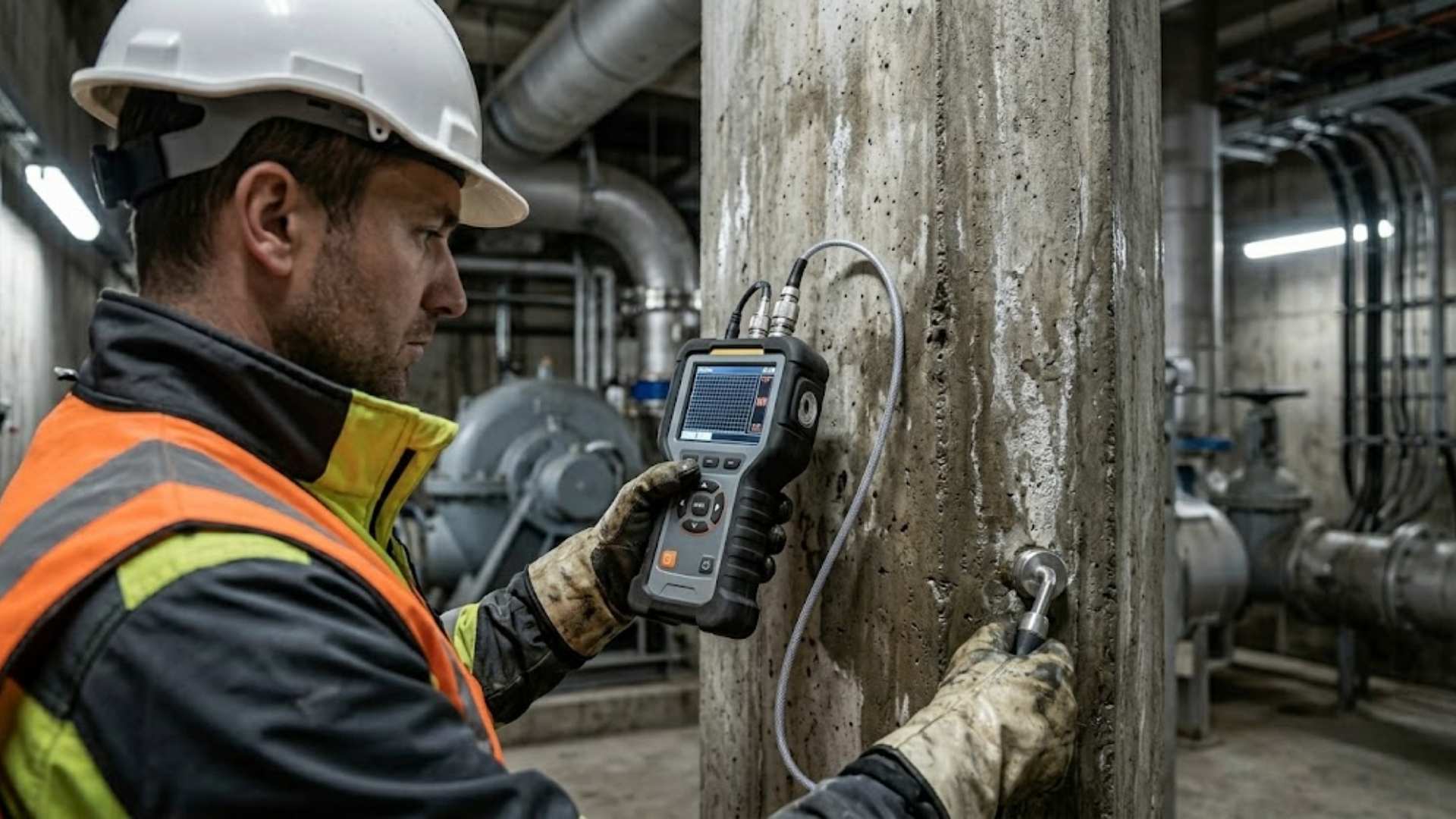
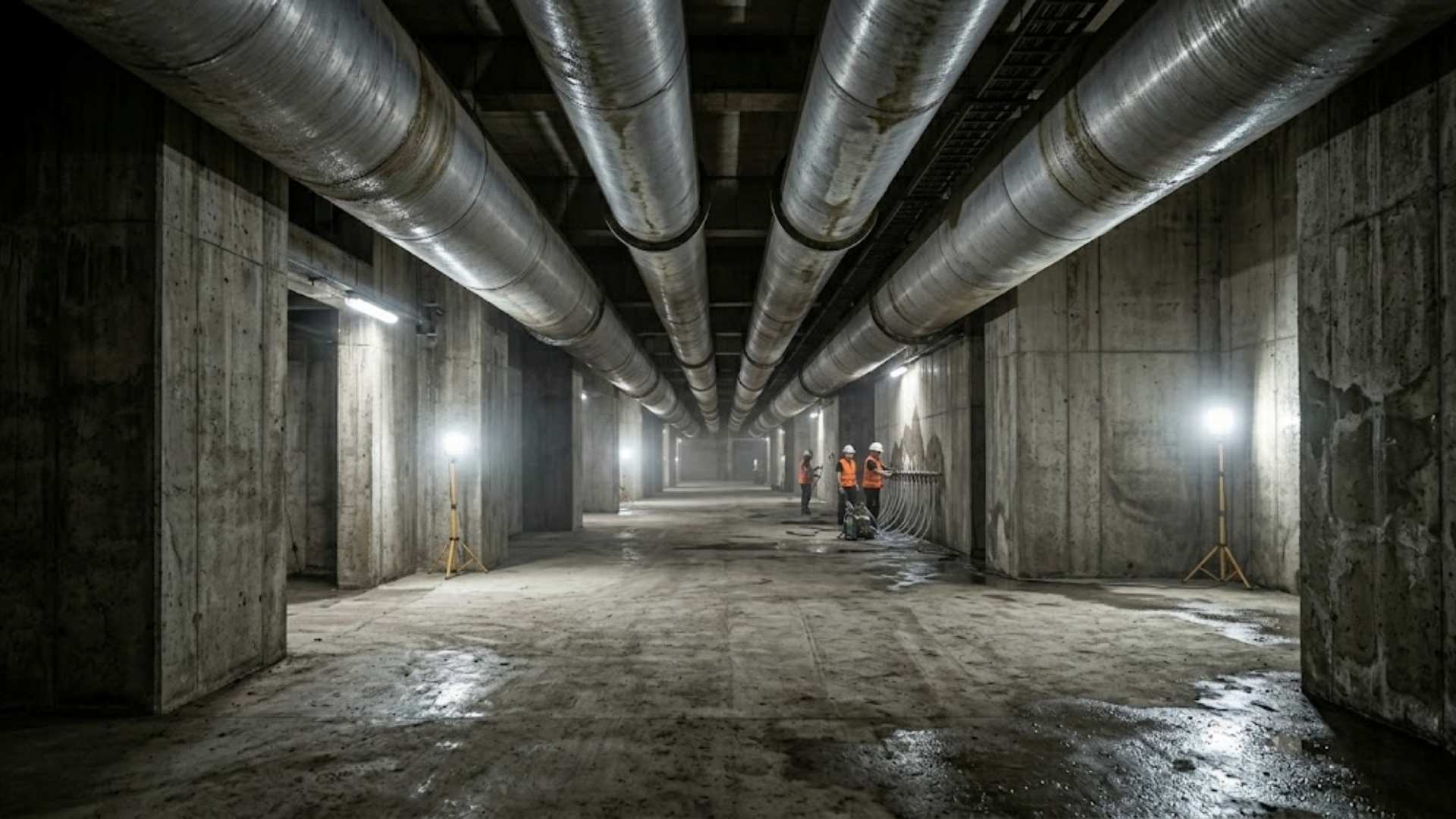
At the Kraftwerk Hamm-Uentrop combined-cycle power station in Germany — a facility operated by the Trianel consortium on behalf of regional municipal utilities — EURAS was called in to address water ingress in underground cooling water galleries. The galleries contained both active leaks at construction joints around pipe penetrations and generalised damp seepage through the gallery lining concrete.
The assessment distinguished the two conditions precisely before any repair work began. The active flow zones around pipe penetration collars were treated first with fast-setting gel to stop the water movement, creating a stable environment for the subsequent injection phase. The distributed seepage zones were then addressed with sustained low-pressure permeation injection to saturate the capillary network in the gallery lining.
The project was completed without shutting down critical cooling systems — a requirement given the plant's operational continuity obligations. Both conditions were resolved permanently in a single campaign.
EURAS Technology has carried out this same dual-condition assessment across dams, tunnels, reservoirs, and basements for more than 25 years. The diagnostic step is never skipped, because misidentification is the primary cause of repeat repair failures in injection waterproofing.
If you are assessing a structure that shows possible active flow alongside generalised dampness, an EURAS pre-injection survey will identify and classify both conditions before work begins.Talk to a technical specialist
"The crack is leaking — just inject it."
A crack leaking under active flow must be stabilised before gel injection. Applying gel to an active flow crack without first stopping the movement is the most common cause of first-pass injection failure.
"The wall is just damp — a surface coating will fix it."
A surface coating applied to a wall with ongoing damp seepage will debond as moisture vapour and osmotic pressure build up behind it. Permeation injection addresses the source within the concrete; surface coatings cannot.
"We used hydrophilic foam last time and it held — that's enough."
Hydrophilic foam is a flow stopper, not a long-term waterproofing material. It will compress over time under sustained hydrostatic load and eventually allow water to bypass it. Foam repairs should always be followed by full-depth gel injection for permanent sealing.
"If there's no visible crack, there's no pathway."
Capillary pore networks in hydrated cement paste — typically from tens of nanometres to about 10 micrometres — are invisible to the naked eye but are fully capable of transmitting significant water volume given sufficient hydraulic head and contact time.
Can active flow and damp seepage occur in the same structure simultaneously?
Yes, and this is common. Construction joints typically produce active flow while surrounding slab or wall concrete shows generalised seepage. They must be assessed and treated separately and in the correct sequence.
How much water flow qualifies as "active" for treatment purposes?
Any visible flow movement — even a slow trickle — qualifies as active for material selection purposes. The rate determines which material to use, but the principle (stop movement before injecting) applies at any visible flow rate.
Can damp seepage cause structural damage even without active cracks?
Yes. Sustained moisture migration through concrete carries dissolved chlorides and carbonates that cause reinforcement corrosion over time. The structural damage from damp seepage may not be visible until spalling occurs years later.
Is there a standard test for flow rate that I can specify?
Flow rate measurement at crack locations can be performed with a calibrated collector vessel and stopwatch. For insurance or warranty purposes, this measurement should be recorded pre- and post-injection as part of the repair documentation.
Can a crystalline waterproofing admixture be used to stop active flow?
No. Crystalline admixtures require mixing with fresh concrete or application to a moist static surface. They cannot seal an actively flowing crack. They are useful as a supplementary barrier applied after the active flow has been stopped by injection.
What happens if the wrong material is used on active water flow?
The gel or grout is washed out by the moving water before it can cure. The repair appears to hold briefly as the flow redistributes, then resumes within hours or days. This is the standard pattern of a misidentified active flow condition treated with a slow-setting material.
How do I specify this distinction in a repair contract?
The specification should require the contractor to carry out a pre-injection condition assessment, classify each ingress point as active flow or seepage, and document the classification before repair begins. Material selection should be tied contractually to the assessment outcome, not pre-specified as a single material for all conditions.
How long does a pre-injection condition assessment typically take?
It depends on structure size and complexity. A focused survey of a few ingress locations may take part of a day; large or complex assets often need multi-day access with moisture profiling, documentation, and reporting. The critical part is that classification is completed before materials are locked in.
Can injection waterproofing be carried out while a structure remains in use?
Often yes. Specialist injection is frequently staged so operational areas stay in service, with localised access and controlled working zones. Active flow may require interim flow stoppage at the repair location, but whole-structure shutdown is not always necessary.
Active water flow and damp seepage are distinct hydraulic conditions that require different materials, different injection techniques, and different sequencing. Treating them identically — which is common practice in non-specialist repair — is the single most predictable cause of repair failure. A correct pre-repair assessment that classifies each ingress condition accurately is the foundation of any successful waterproofing programme. For related reading, see why concrete structures can leak after waterproofing and mineral gel vs polyurethane injection — which to specify.
If you are assessing water ingress in a structure and need to determine the correct repair approach, request a specialist pre-injection survey.
Request a site survey | Learn about our water leak detection service