
+1 (954) 787-2570

Email: hello@eurastechnology.com


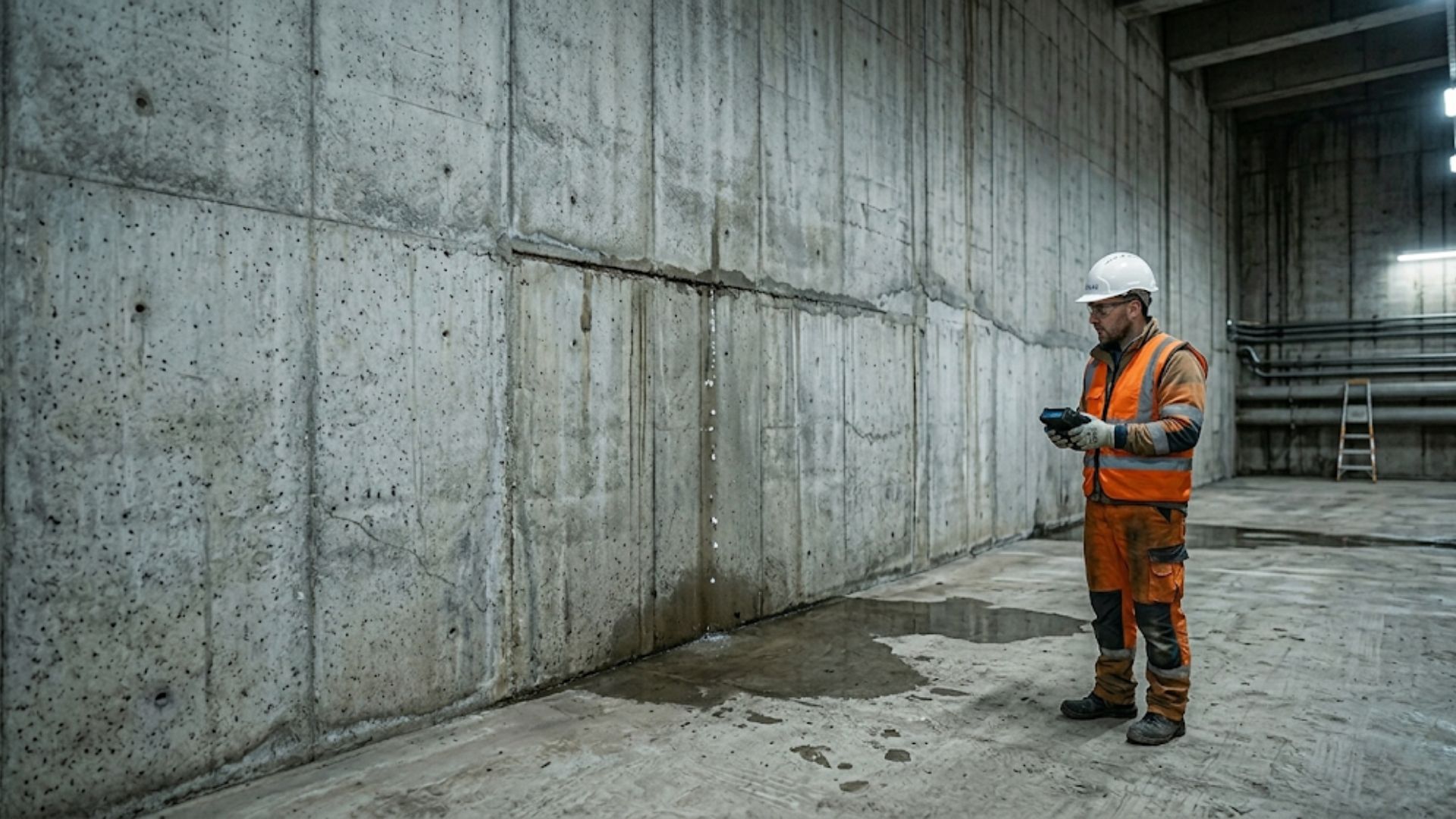
Original waterproofing does not guarantee a watertight structure indefinitely. Most underground concrete structures that experience water ingress were waterproofed during construction — the waterproofing simply failed after the fact. Understanding why is the first step to choosing a repair strategy that addresses the actual cause rather than the visible symptom.
This article explains the seven main reasons construction-era waterproofing fails in reinforced concrete structures, and what those failure modes mean for specification of a durable repair.
Even correctly installed waterproofing systems have a finite service life and predictable failure modes.
There is a widespread assumption in the industry that a waterproofed structure is a permanently watertight structure. It is not. A more accurate framing is that a waterproofed structure was watertight on the day of installation, within the tolerances of the system specified, under the conditions present at the time.
The British Standard BS 8102:2022 — Protection of below-ground structures against water ingress — is explicit on this point. It classifies waterproofing performance by grade (Grade 1–4), acknowledges that no system guarantees absolute exclusion of water, and recommends combined-system approaches for structures where any ingress is unacceptable. Most structures built before the 2022 revision were designed to earlier editions that lacked the same emphasis on performance grades and combined protection for high-consequence applications.
Understanding the failure modes built into original construction-era waterproofing allows engineers to diagnose active problems accurately and specify lasting remediation rather than repeated temporary fixes. For how Type B (structurally integral) concrete relates to injection repairs under BS 8102, see Type B waterproofing, BS 8102, and injection systems.
Every pour boundary in a concrete structure creates a construction joint. In a typical underground basement or retaining wall, there will be at least four: wall-to-foundation, wall-to-slab, and two or more vertical pour stops in long sections of wall.
Construction joints represent the single most common ingress point in leaking underground structures. The reason is straightforward: concrete cast at different times does not bond monolithically. Even with proper surface preparation and waterstop installation, the interface between old and new concrete remains a discontinuity in the waterproof system.
Why original waterstops fail:
When groundwater begins applying sustained hydrostatic pressure to a construction joint, even a small loss of seal integrity creates a concentrated ingress pathway. High-pressure gel injection from the interior — negative-side injection — addresses the joint within the concrete rather than relying on a new surface coating, and avoids perimeter excavation in most existing assets.
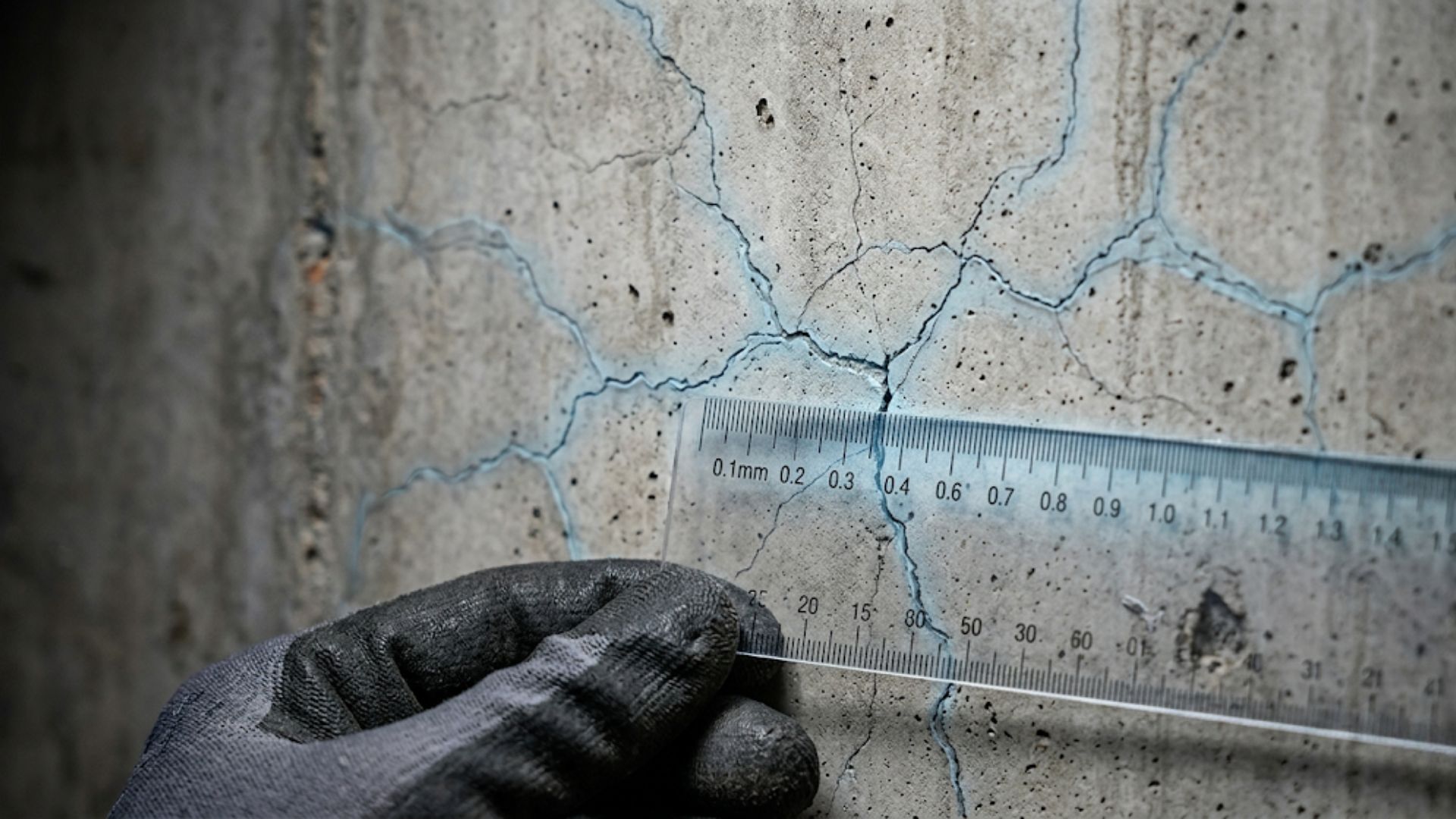
Plastic shrinkage and autogenous shrinkage begin within hours of casting. Drying shrinkage continues for months or years afterward. The result is a predictable micro-crack network that develops independently of applied loads. CIRIA C766 — Control of cracking caused by restrained deformation in concrete gives engineers a structured basis for restraint, crack-inducing strain, and crack width — directly relevant when diagnosing shrinkage-related breaches of the waterproof envelope.
External waterproofing membranes — whether applied before or immediately after formwork strikes — are applied to concrete that has not yet fully shrunk. As the concrete shrinks away from an applied membrane, the bond reduces. In areas of concentrated stress (internal corners, slab edges, penetrations), shrinkage cracks can break through the membrane or cause delamination of a cementitious coating.
This is why BS 8102:2022 advises that integral concrete protection (structural waterproofing admixtures, crystalline systems) should complement external membranes rather than rely on membranes alone for concrete of complex geometry. For existing structures already showing shrinkage-related ingress, injection waterproofing that penetrates and fills the micro-crack network from within is the most technically appropriate repair.
Reinforced concrete structures move. Seasonal thermal cycling causes expansion and contraction. Foundation settlement — even within acceptable limits — creates differential displacement across a structure. Vibration from traffic, machinery, or seismic events imposes cyclic loading.
Applied waterproofing systems that rely on surface adhesion or rigid barriers are designed for the geometry of the structure at installation. Once the structure moves — even by a fraction of a millimetre — the seal between a membrane and the concrete substrate may break. Crystalline systems that penetrate the concrete matrix handle movement better than surface-applied coatings, but they too have limits in structures with significant differential movement.
For engineers specifying waterproofing repair in structures that have undergone measurable settlement, any repair system must accommodate future movement. Elastic injection gels — particularly mineral-based systems — remain permanently flexible after cure, meaning they absorb micro-movement without losing seal integrity.
External waterproofing membranes are typically designed to resist a defined hydrostatic pressure head at the time of specification. Over time:
The failure is progressive. What begins as a small pinhole becomes a propagating delamination zone as trapped water redistributes under pressure. By the time active ingress is visible internally, the membrane may have failed across a much larger area than is apparent from the water entry point.
Rubber and PVC waterstops embedded in construction joints are designed to last. However, they can fail through:
In all these cases, the waterstop provides no effective barrier despite appearing intact from core extraction samples. Injection waterproofing that bypasses the failed waterstop and fills the joint from within is the preferred remediation approach.
Every pipe, conduit, sleeve, anchor bolt, and tie rod that passes through a waterproofed concrete wall is a penetration. Each penetration represents a discontinuity in the waterproofing system that was sealed individually during construction — typically with a flexible sealant or an applied collar.
Over time:
Penetration leaks are common, often small in volume initially, but disproportionately damaging because water tends to track along service runs into building interior spaces.
Where concrete faces cyclic freezing and thawing while saturated or near-saturated, expanding pore ice and repeated thermal strain widen micro-cracks and open joint interfaces. Alpine hydropower, northern road tunnels, and cold-climate basement walls are typical exposure contexts. Original external membranes and surface coatings cannot follow every opening crack; water then reaches the crack network behind the barrier.
For assets in these environments, repairs must use materials that remain elastic after cure and tolerate wet substrate conditions — rigid cementitious grouts and brittle epoxies are often poor matches where movement and frost cycles continue after remediation.
At the Melchsee-Frutt hydropower facility in Obwalden, Switzerland — a high-altitude station embedded in Alpine geology — EURAS encountered exactly these failure modes in combination. The surge chamber and tunnel connections had been waterproofed during original construction, but chronic water ingress had developed at construction joints and micro-cracks formed by freeze-thaw cycling of the rock mass.
Conventional cement grout had been used for previous repair attempts and had failed repeatedly — because it is rigid and cannot accommodate the structural movement inherent in a facility operating at altitude with large seasonal temperature swings. EURAS® Gel Type B was injected under high pressure (up to 160 bar) through ports drilled to intersect the joint and crack network from within the structure. The elastic gel permanently filled and sealed the ingress paths while retaining the flexibility required to survive future thermal movement.
EURAS Technology has operated across 25+ years of critical infrastructure waterproofing. Our teams have addressed these failure modes in dams, tunnels, reservoirs, basements, and car parks across Europe and North Africa. If you are seeing ingress in a structure that was waterproofed during construction, you are not looking at a design failure — you are looking at a predictable material response to time and load.
If you are diagnosing water ingress in a structure with original waterproofing, our technical team can review the failure mode and advise on the appropriate intervention.Talk to a technical specialist
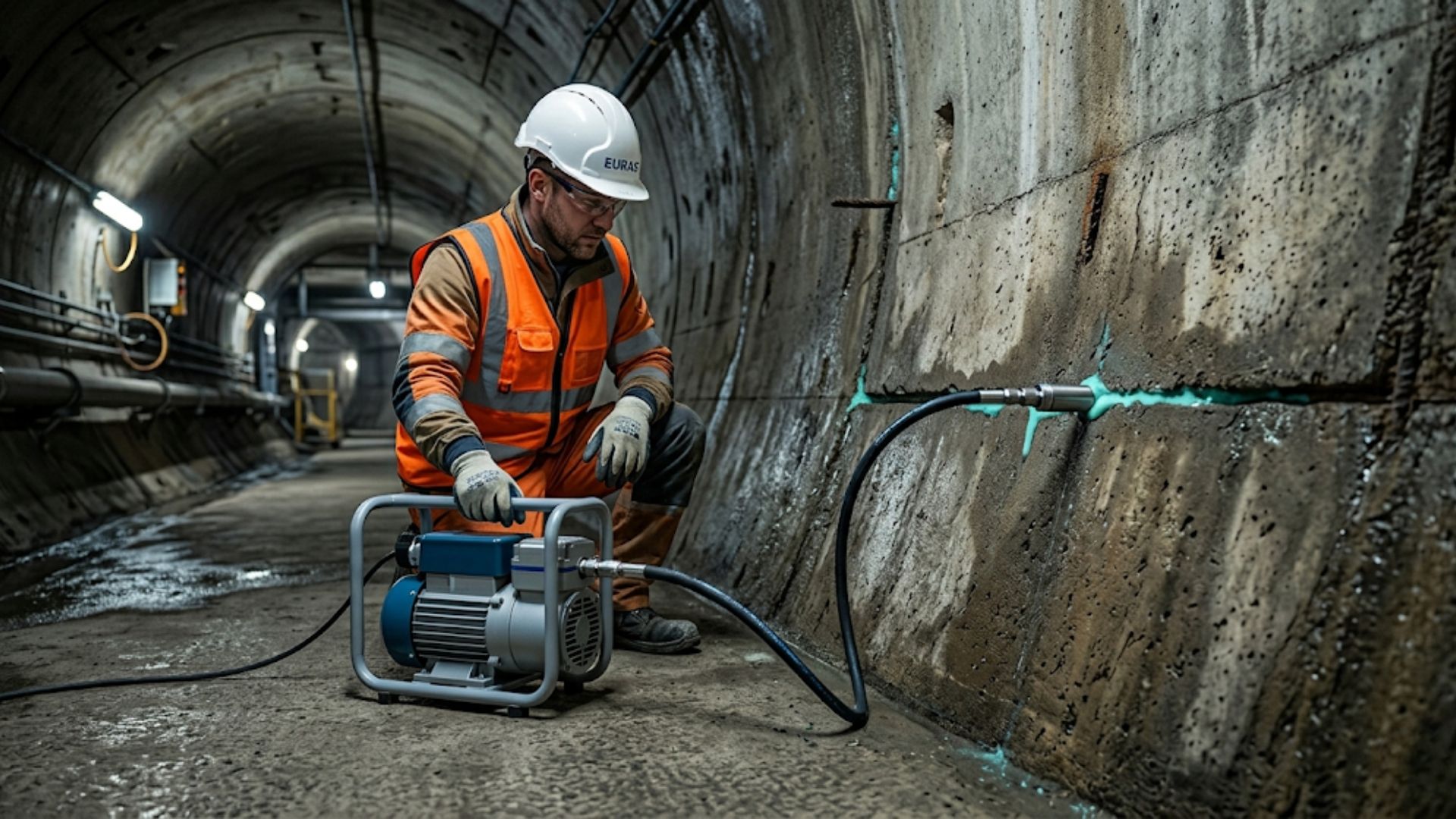
Once the failure mode is identified, repair specification should match the mechanism:
For each repair, a non-destructive structural assessment should precede specification to map the extent of the problem and confirm there is no secondary cause (reinforcement corrosion, significant concrete degradation) that requires structural repair prior to waterproofing.
Learn more about our foundation repair capabilities where structural movement or bearing capacity must be stabilised before waterproofing is finalised.
Matching the repair to the mechanism is the starting point — but correct specification also depends on understanding hydraulic conditions at each ingress point. If the failure mode is not yet clear, our non-destructive testing service can support diagnosis before injection is designed. When you are ready for a site-specific brief, request a specialist survey.
Can a structure's original waterproofing be repaired from outside once it has failed?
Exterior excavation and membrane replacement is technically possible but is rarely practical for occupied structures. Cost and disruption make it prohibitive in most cases. Interior injection repair from the dry side — negative-side injection — is the standard approach for existing structures.
How do I tell if the ingress is through a construction joint or a structural crack?
Construction joints are horizontal or vertical straight lines corresponding to pour boundaries. Structural cracks typically follow stress paths — diagonal at corners, vertical in spanning elements. A moisture mapping survey or non-destructive testing can confirm the source.
Does the age of the original waterproofing affect the repair approach?
Yes. Older bituminous membranes may have embrittled; older PVC waterstops may have degraded. The repair specification should account for substrate condition, not just the visible ingress point.
\Why does gel injection work in wet and saturated concrete while cement grout does not?
Portland cement grouts require a clean, damp but not saturated substrate for hydration. In active leak conditions, water washing through the crack dilutes and prevents cement from setting. Mineral gel systems are hydrophilic — they absorb and displace water rather than being disrupted by it.
Can the same crack be re-injected if the first attempt fails?
Yes. Injection ports can be re-drilled and the material re-injected. However, repeat failure of the same joint or crack after correct injection usually indicates continued structural movement — the repair specification needs to address the movement rather than just the crack.
What documentation should I produce after a waterproofing repair?
For warranted works, produce a pre-intervention condition survey, injection records (pressure, volume, port-by-port), post-intervention moisture mapping, and a performance statement. For critical infrastructure, third-party inspection of injection completion is recommended.
Can waterproofing fail within 10 years of construction?
Yes. Shrinkage-related micro-cracks can cause membrane debonding within the first 5 years. Construction joint leaks typically manifest within 2–10 years of handover as initial hydrostatic head builds and original sealant components begin to age.
Should the original contractor be liable if waterproofing has failed prematurely?
This is a contractual and legal question beyond the scope of technical specification. However, documenting the failure mode with a specialist assessment report can support any commercial discussion.
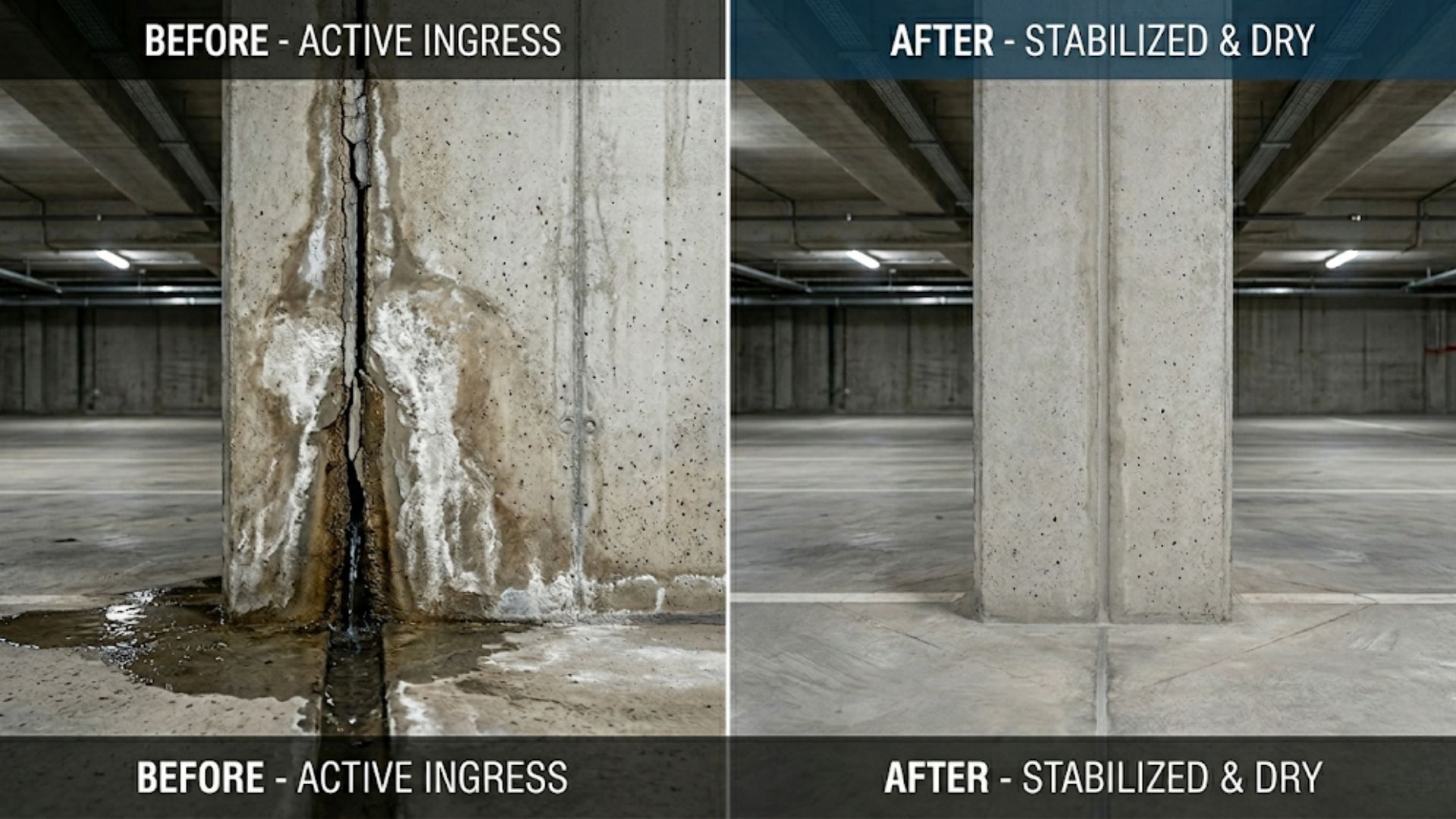
Concrete structures leak after waterproofing because waterproofing materials have service lives, and concrete structures are not static systems. Construction joints, concrete shrinkage, structural movement, hydrostatic pressure cycling, embedded waterstop degradation, penetration seal failure, and freeze–thaw / environmental cycling are all normal and predictable failure mechanisms. Recognising which one is active in a given structure is the essential first step to specifying a repair that lasts.
If you are assessing water ingress in a structure with original waterproofing, request a specialist site survey to identify the failure mode before specifying remediation.


