
+1 (954) 787-2570

Email: hello@eurastechnology.com


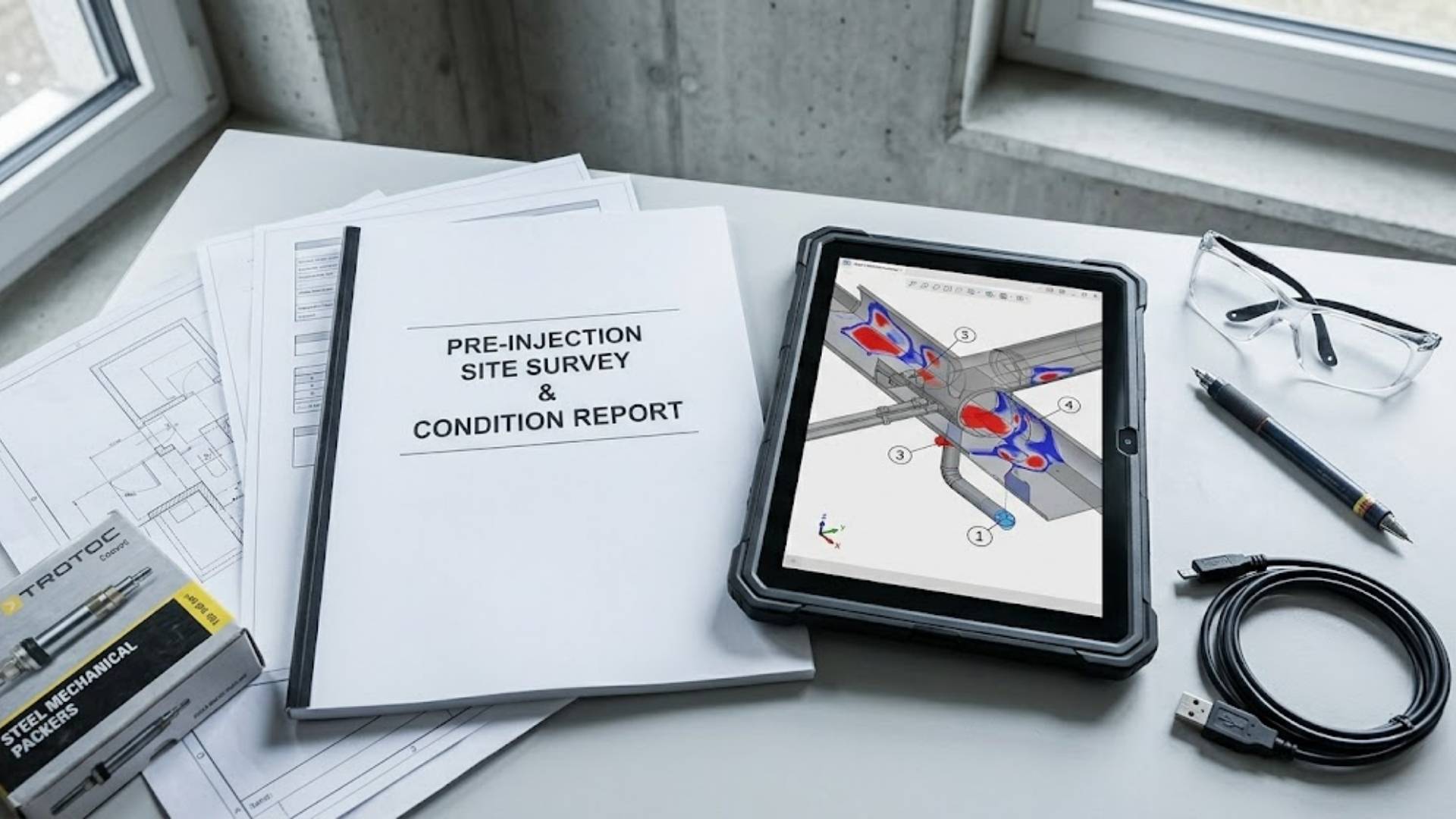
A waterproofing survey is not a formality before a contractor starts work. It is the document on which the entire repair specification depends — the wrong specification based on an incomplete survey produces a failed repair. Understanding what a thorough survey looks like allows you to hold a contractor accountable to the standard of assessment your structure deserves.
This article explains exactly what a competent pre-injection waterproofing site survey should cover, in the order it is typically completed, and the questions you should ask at each stage.
A complete pre-injection waterproofing site survey produces a written condition report that covers six areas.
A survey that produces only photographs and an indicative price is not a waterproofing survey — it is a site visit.
The waterproofing repair of an underground structure is a diagnosis-before-treatment task. You cannot specify the correct material, the correct method, or the correct programme until you know the precise hydraulic condition at each ingress point, the structural context that produced it, and the constraints on access and method for the repair.
Every failed waterproofing repair — and there are many — can be traced to one of three failures upstream of the repair itself:
A competent pre-injection survey eliminates all three.
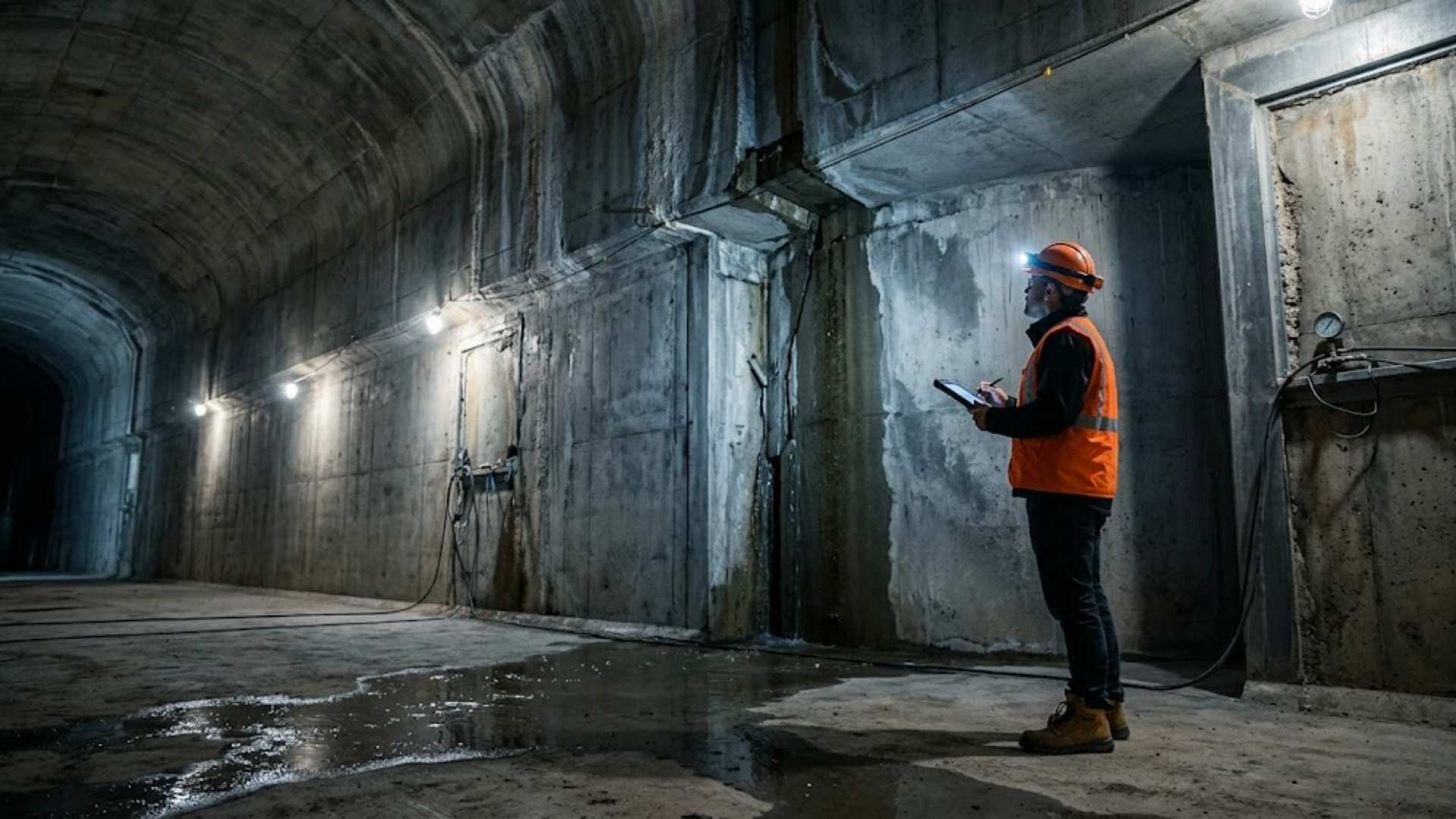
Before the surveyor inspects the ingress, they need to understand the structure they are surveying. This establishes the framework for everything that follows.
The surveyor should establish:
This context is not administrative box-ticking. It determines where to look for ingress beyond the obvious visible points.
The most critical component of the survey is the ingress mapping. A competent surveyor inspects the entire structure — not just the areas of visible dampness — because:
For each identified ingress point, the surveyor must classify:
The surveyor should use a calibrated moisture meter to profile the moisture distribution across wall areas that appear uniformly damp, to identify whether there are concentrated ingress pathways hidden beneath the surface dampness.
Classifying flow correctly drives material choice — see our guide to active water flow vs damp seepage in concrete for how those differences affect specification.
The injection specification depends on understanding the hydraulic head acting on the structure — how much water pressure is the injection gel working against.
The surveyor should:
This informs the injection pressure specification and material reactivity. A structure with a lower head may allow lower working pressures and more time for gel saturation; a structure with a much higher head typically needs higher initial working pressure and faster-reacting materials so the gel does not blow back before it sets. The Concrete Centre’s guidance on watertight concrete to BS 8102:2022 helps relate groundwater context to system expectations.
Where moisture pathways are hidden, ground-penetrating radar can support mapping when scoped as part of the survey.
Based on the ingress classification and hydraulic assessment, the survey report should specify the proposed injection material for each condition type and explain why.
Expect to see:
For active water flow at construction joints: fast-gel mineral injection, potentially with a foam pre-plug for high-volume flow For distributed seepage through sound concrete: permeation gel injection to seal pathways from within — or, where seepage is low-pressure and reliable surface preparation is achievable, crystalline treatment applied to the concrete face (a different system class from injection; the survey should state which approach matches the condition) For static cracks: standard mineral gel injection at calculated pressures
For how EURAS turns survey findings into a written injection programme, see concrete crack injection.
Be suspicious if:
The survey should translate the condition assessment into a specific injection programme:
Sequencing logic in practice: treating the highest-energy leaks first limits downstream re-wetting of completed zones and reduces the risk of gel washout in adjacent paths.
The survey should close with practical programme information:
A survey that does not produce a written report is not a survey. At minimum, the written output should include:
The report should also acknowledge known uncertainties — concealed cracks or pathways that may only appear once injection begins — and recommend a schedule of rates or agreed variation mechanism for additional ingress found during the works. A report that claims complete certainty about every pathway is overstating what a surface-based survey can prove.
This document is your basis for comparing contractors, your reference during the works, and your audit trail after completion.
At PAP Lisina — the HE Vrla hydropower facility in Serbia — active leaks had developed in the valve chamber and adjacent tunnel areas. Previous repair attempts had failed. When EURAS was engaged, the response began with a targeted assessment of the valve chamber geometry, the construction joint locations, the pressure conditions acting on the structure, and the specific failure mode of previous repairs.
That pre-injection assessment determined that the leak pathways were within the concrete and accessible from within the chamber — conventional surface treatment was ineffective because it had not addressed the joint at depth. EURAS® Gel Type B was injected at up to 150 bar, targeting the joints at depth rather than the surface.
The repair was completed within 48 hours. The survey quality — specifically the identification of the correct repair depth and the failure mode of previous attempts — was what made that speed possible. A generic survey would have recommended repeating the same approach that had already failed.
EURAS's pre-injection site survey is always the starting point for any engagement. On reservoir and potable-water assets, comparable rigour applies — for example Hoch-Behälter Usingen, where material approval and hydraulic head defined the injection specification. If you are assessing contractors and want to understand what a condition-based survey looks like in practice, contact us to arrange a survey at your structure. Request a site survey
Use these questions to assess whether a survey report meets the standard you should expect:
If the answer to most of these questions is no, the survey is insufficient to base a repair specification on.
How long should a pre-injection waterproofing survey take?
For a small structure (single basement, one level, limited ingress points): 1–3 hours on site. For a larger structure (multi-level car park, tunnel section, reservoir): half a day to a full day. Allow time for the surveyor to complete a thorough inspection — a 30-minute site visit for a complex structure is not a survey.
Should I pay for the survey, or should the contractor provide it free?
Credible specialists may provide preliminary site surveys free of charge as part of the quoting process, or at a nominal fee that is credited against the contract. If the survey is free, confirm that a written condition report will be produced — not just a quotation. An unbilled survey that produces no written report is of limited value.
Can I get ground penetrating radar or infrared thermography as part of the survey?
Yes — these non-destructive testing methods can be included in a survey for structures where the extent of moisture migration is not visible from the surface. Ask the contractor to scope the NDT as a specific survey component.
What happens if additional ingress points are found during injection that were not identified in the survey?
Any survey of a water-ingress structure carries some uncertainty — concealed cracks and pores may not be visible until injection gel begins to migrate toward them. A good contract provides a mechanism (schedule of rates or agreed variation procedure) for addressing additional ingress points found during the works.
Should the surveyor be the same person who will carry out the injection?
Yes, ideally. Continuity between the surveyor and the injection operative means the specification and the execution are directly aligned. If different people are doing these roles, confirm that there is a clear handover brief.
How do I know the surveyor is qualified to assess injection conditions?
Ask what training or certification they hold in injection waterproofing assessment — not general waterproofing. Ask how many injection projects they have been personally involved in assessing. A surveyor who has not personally performed injection waterproofing will not produce as reliable a condition assessment as one who has.
A waterproofing site survey is the document on which your repair is built. An incomplete survey — missing ingress points, wrong hydraulic classification, no material rationale — leads directly to a failed or incomplete repair. Use the six-component framework in this article to assess every survey report you receive, and hold contractors accountable to the standard that gives your structure a permanent repair rather than a repeated one.
To request a condition-based site survey of your structure — one that produces the written report standard described here — contact EURAS.
Request a site survey | Choosing a specialist injection waterproofing contractor | Emergency leak repair if ingress is accelerating now


